
DIY Backup Power System: The Complete Planning & Build Guide
Everything homeowners, off-grid enthusiasts, and small business owners need to plan, size, and safely assemble a reliable DIY Backup Power System — from battery banks and pure sine wave inverters to solar charging and transfer switches.
What Is a DIY Backup Power System?
A DIY Backup Power System is a self-assembled electrical setup that keeps essential household circuits running when utility power fails. Instead of relying entirely on the grid, homeowners combine a battery bank, an inverter, a charging source such as solar panels or a generator, and safety equipment like breakers and a transfer switch into one coordinated unit. The goal is simple: convert stored or generated energy into usable household electricity during a power outage, storm, or off-grid situation.
Unlike a single portable generator, a well-planned backup power system blends multiple technologies — battery storage, solar charging, and sometimes fuel-based generation — into a layered strategy. This approach is popular among homeowners, RV owners, off-grid enthusiasts, and small business owners who want dependable emergency backup power without the recurring cost and noise of running a generator continuously.
How Backup Power Systems Work
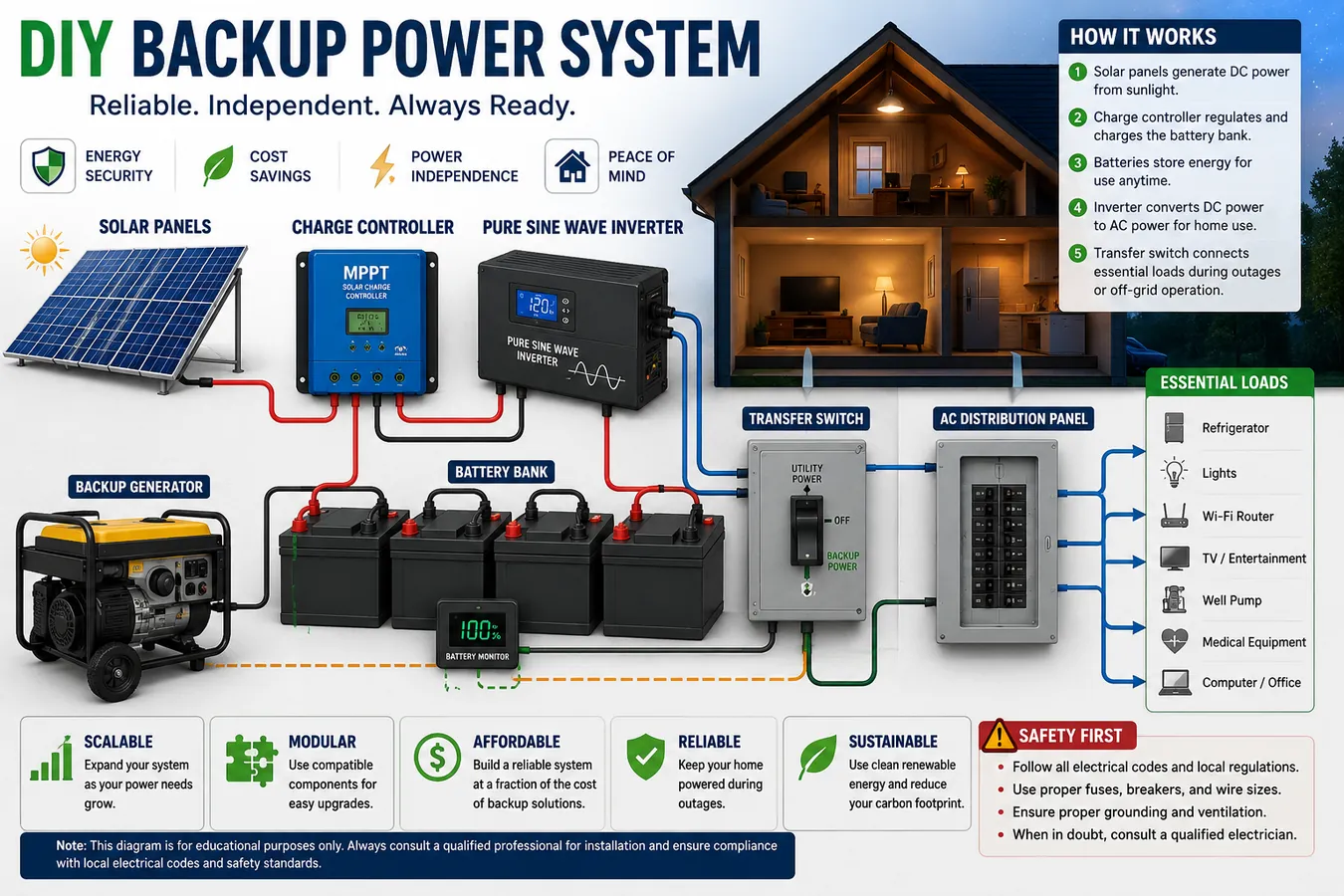
At its core, a backup power system stores electrical energy in batteries and converts it from direct current (DC) to alternating current (AC) so it can run standard household appliances. Solar panels or a generator recharge the batteries, a charge controller regulates that charging process, and an inverter delivers clean, usable power to your essential loads. When utility power drops, a transfer switch isolates your home's backup circuits from the grid, preventing dangerous backfeed and allowing the battery-inverter combination to take over seamlessly.
Understanding this chain — generation, storage, conversion, distribution — is the foundation of every decision you'll make while sizing and building your own system.
Benefits of Having Backup Power
Reliability During Outages
A properly sized home backup power system keeps refrigerators, medical equipment, and communication devices running when the grid goes down, reducing spoiled food, safety risks, and lost productivity.
Energy Independence
Pairing solar panels with battery storage lets you generate and store your own electricity, reducing dependence on the utility grid and, in many regions, lowering monthly energy bills over time.
Quiet, Clean Operation
Battery-based systems combined with a pure sine wave inverter run silently and produce clean power suitable for sensitive electronics, unlike many portable generators.
Scalable Investment
You can start small — a single battery and inverter for critical loads — and expand your battery bank, solar array, or generator capacity as your budget and needs grow.
When You Need Backup Electricity
Common triggers for investing in emergency backup power include frequent utility outages, severe weather regions (hurricanes, ice storms, wildfires), remote or rural properties with unreliable grid service, home medical equipment that requires uninterrupted power, and off-grid or RV living where there is no utility connection at all.
Planning Your Backup Power System
Good system design starts on paper, not at the hardware store. Before buying any equipment, take time to understand your electrical loads, your daily energy consumption, and your peak power demand.
Understanding Electrical Loads
Every appliance draws a certain wattage while running, and many draw a much larger "surge" wattage for a moment when they start. Refrigerators, well pumps, and air conditioners are classic examples of loads with high starting surges. List every device you want to back up, along with its running watts and, where available, its surge watts.
Calculating Daily Energy Consumption
Daily energy consumption is measured in watt-hours (Wh) or kilowatt-hours (kWh). Multiply each appliance's running wattage by the number of hours you expect to use it per day, then add all appliances together. This total tells you how much energy your battery bank and any charging source need to replace every 24 hours.
Determining Peak Power Requirements
Peak power is the highest wattage your system must supply at any single moment — usually when several appliances start simultaneously or one large motor-driven appliance surges. Your inverter and wiring must be sized to handle this peak, not just your average daily draw, or the system will trip breakers or shut down under load.
Choosing Essential Appliances
Most DIY systems focus on a curated list of essential circuits rather than the whole house: refrigerator, freezer, well pump, furnace blower, lighting circuits, internet router, medical devices, and a few outlets for phone charging and small electronics. Prioritizing these loads keeps your battery bank and inverter size — and your budget — reasonable.
System Components
A complete DIY Backup Power System is built from a set of components that each play a specific role in generating, storing, converting, and safely delivering electricity.
Battery Bank
The battery bank stores energy for use when solar or generator charging isn't available. Capacity is measured in amp-hours (Ah) or kilowatt-hours (kWh), and chemistry choice (covered in detail below) affects lifespan, weight, and cost.
Pure Sine Wave Inverter
The inverter converts stored DC battery power into clean AC power that matches utility-grade waveform quality, making it safe for sensitive electronics, motors, and medical devices.
Solar Panels
Solar panels convert sunlight into DC electricity that recharges the battery bank, extending runtime without fuel and reducing reliance on a generator.
Charge Controller
A charge controller regulates the voltage and current coming from solar panels (or other DC sources) into the battery bank, preventing overcharging and extending battery life. MPPT (Maximum Power Point Tracking) controllers are generally more efficient than older PWM types.
Transfer Switch
A transfer switch isolates your backup circuits from the utility grid during an outage, preventing dangerous backfeed onto utility lines and protecting utility workers. Transfer switch installation involving grid-connected circuits should be performed by a licensed electrician.
Circuit Breakers
Breakers protect wiring from overcurrent by automatically interrupting the circuit if current exceeds a safe threshold, reducing fire risk.
Fuses
Fuses provide sacrificial overcurrent protection, especially on DC battery cables, and are essential near the battery bank and inverter input.
Battery Monitor
A battery monitor tracks state of charge, voltage, current draw, and remaining runtime, giving you real-time visibility into system health.
Generator
A portable or standby generator provides a fuel-based backup charging source and can directly power loads or recharge the battery bank during extended outages or low solar production.
DC Disconnect
A DC disconnect allows you to safely isolate the battery bank from the rest of the system for maintenance or emergency shutdown.
Grounding System
Proper grounding protects people and equipment from fault currents and static buildup. Grounding requirements vary by jurisdiction and system type, so consult your local electrical code and a licensed electrician.
Power Distribution Panel
This panel organizes breakers for each backed-up circuit, distributing power from the inverter to individual loads throughout the home.
Cables and Connectors
Properly sized cables and secure connectors minimize voltage drop and heat buildup — undersized cabling is a leading cause of DIY system failures and fire risk.
Battery Enclosure
An enclosure protects batteries from physical damage, dust, and moisture while containing any potential venting in the rare case of a fault.
Cooling and Ventilation
Batteries, inverters, and generators all generate heat and, in some chemistries, gases during charging. Adequate ventilation prevents heat buildup and, for lead-based batteries, disperses hydrogen gas safely.
Battery Options
Choosing the right chemistry for your battery bank affects cost, lifespan, weight, and maintenance requirements.
| Chemistry | Advantages | Disadvantages | Typical Cost | Cycle Life | Maintenance |
|---|---|---|---|---|---|
| Lead Acid (Flooded) | Low upfront cost, widely available | Heavy, requires watering, off-gassing | Low | 300–500 cycles | High |
| AGM | Sealed, spill-proof, moderate cost | Shorter life than lithium, weight | Moderate | 400–600 cycles | Low |
| Gel | Deep discharge tolerant, sealed | Sensitive to overcharging | Moderate | 500–800 cycles | Low |
| LiFePO4 (Lithium) | Long life, lightweight, high efficiency | Higher upfront cost | High | 3,000–6,000+ cycles | Very Low |
Lead acid remains popular for tight budgets, while Lithium Iron Phosphate (LiFePO4) has become the preferred chemistry for serious home energy storage thanks to its long cycle life, light weight, and minimal maintenance — despite a higher initial price tag.
Inverter Types
The inverter you choose determines which appliances you can safely run and how clean your output power will be.
| Inverter Type | Output Quality | Best For | Relative Cost |
|---|---|---|---|
| Pure Sine Wave | Utility-grade waveform | Electronics, medical equipment, motors | Higher |
| Modified Sine Wave | Stepped, less clean | Basic tools, resistive loads | Lower |
| Hybrid Inverter | Sine wave with built-in charge control | Solar + battery + grid integration | High |
| Off Grid Inverter | Sine wave, standalone | Remote cabins, no grid connection | Moderate–High |
For most home backup applications, a pure sine wave inverter is strongly recommended since modified sine wave output can cause humming, reduced efficiency, or damage in sensitive electronics and motor-driven appliances.
Backup Power Sources
Beyond the battery bank itself, several charging sources can keep your system topped up.
Solar Power
Solar panels offer free, quiet, renewable recharging but depend on sunlight availability and panel size.
Portable Generator
Portable generators provide flexible, on-demand power and can recharge batteries quickly, but require fuel storage and outdoor operation for exhaust safety.
Standby Generator
Permanently installed standby generators start automatically during an outage and can power a home directly, often integrated with an automatic transfer switch installed by a licensed electrician.
Wind Turbine
Small wind turbines can supplement charging in consistently windy locations, though output is less predictable than solar in most residential settings.
Micro Hydro
For properties with flowing water, micro hydro systems can provide continuous, weather-independent charging, though site requirements are specific.
Battery Storage (Grid-Charged)
Some systems simply charge the battery bank from the grid during normal operation, providing a UPS-style buffer for outages without any renewable generation.
Hybrid Systems
Combining solar, battery storage, and a generator provides the most resilient setup: solar handles daily charging, batteries absorb short outages, and the generator covers extended low-sun periods.
System Design
Every backup power system moves energy through the same basic chain: generation (solar, generator, or grid) → storage (battery bank) → conversion (inverter) → distribution (panel and circuits) → your home's essential loads.
AC vs DC Power
Solar panels and batteries produce DC power, while household appliances run on AC power. The inverter is the bridge between these two worlds, while the charge controller manages DC charging into the battery bank.
Voltage Selection
| System Voltage | Typical Use Case | Notes |
|---|---|---|
| 12V | Small systems, RVs, single appliances | Higher current, thicker cables needed |
| 24V | Mid-size home backup systems | Balanced cost and efficiency |
| 48V | Larger whole-home or off-grid systems | Lower current, thinner cables, higher efficiency |
Backup Runtime and System Expansion
Runtime depends on battery capacity versus your connected load. Many DIY builders start with a modular design — extra battery slots, a charge controller with reserve capacity, and busbars sized for future expansion — so the system can grow as needs change.
Home Applications
A typical essential-loads backup system powers: lighting circuits, the refrigerator, internet router and modem, a television, medical equipment, the security system, a well pump, a small window air conditioner, a computer, and a home office setup. Prioritizing these loads over full-house coverage keeps your battery bank and inverter size manageable and affordable.
Installation Overview
The following is a high-level overview of the installation process. It is not a step-by-step wiring guide — any connection to your home's grid-tied electrical panel should be completed or inspected by a licensed electrician in accordance with your local electrical code.
- Planning — finalize your load list, battery capacity, and inverter size before purchasing equipment.
- Selecting equipment — choose components rated for your calculated peak and daily loads with a safety margin.
- Mounting components — secure batteries, inverter, and charge controller in a ventilated, temperature-stable location.
- Cable routing — route DC and AC cabling separately, using proper strain relief and conduit where required.
- Battery placement — position batteries on a stable, non-combustible surface with clearance for ventilation.
- Grounding — bond the system according to manufacturer instructions and local code, using a qualified electrician for grid-interactive grounding.
- Testing — verify voltages, connections, and breaker function before connecting live loads.
- Inspection — have the completed system inspected by a licensed electrician or local authority where required before relying on it during an outage.
Maintenance
Battery Maintenance
Check terminals for corrosion, monitor state of charge, and follow the manufacturer's watering schedule for flooded lead-acid batteries.
Solar Panel Cleaning
Remove dust, pollen, and debris periodically to maintain rated output, especially after storms or dry seasons.
Generator Servicing
Change oil, inspect spark plugs, and run the generator periodically under load to keep it ready for emergencies.
Cable Inspection
Look for fraying, loose lugs, or heat discoloration at connection points at least twice a year.
Cooling Inspection
Ensure vents and fans on inverters and battery enclosures remain unobstructed by dust or debris.
Firmware Updates
Many modern inverters, charge controllers, and battery monitors receive firmware updates that improve efficiency and safety features.
System Monitoring
Use a battery monitor or app-based dashboard to track performance trends and catch problems early.
Seasonal Maintenance
Adjust maintenance schedules for temperature extremes — batteries lose capacity in cold weather and can overheat in summer without adequate ventilation.
Safety
Because backup power systems involve stored energy, combustion equipment, and connections that can interact with the utility grid, final installation and any grid-tied connections should always be performed by a qualified, licensed electrician in compliance with the National Electrical Code (NEC) and local permitting requirements.
Common Mistakes
- Undersized inverter — failing to account for surge wattage from motors and compressors.
- Incorrect battery sizing — not enough capacity for the desired runtime.
- Poor ventilation — trapping heat or gases around batteries and inverters.
- Improper grounding — increasing shock risk and equipment damage potential.
- Ignoring surge loads — overlooking the brief high-wattage draw when appliances start.
- Overloading the system — connecting more devices than the inverter or wiring can handle.
- Wrong cable size — causing voltage drop, overheating, and fire risk.
- Poor maintenance — skipping inspections that catch small issues before they become failures.
Cost Guide
| System Size | Typical Equipment Cost | Use Case | Expected Lifespan |
|---|---|---|---|
| Small (essentials only) | Entry-level | Lighting, router, phone charging | 5–10 years (battery-dependent) |
| Medium (partial home) | Mid-range | Refrigerator, well pump, select circuits | 8–15 years |
| Large (whole-home backup) | Premium | Most household circuits, extended runtime | 10–20+ years (with lithium) |
Total cost depends heavily on battery chemistry, inverter capacity, and whether solar panels and a generator are included. LiFePO4 systems cost more upfront but typically offer a better long-term return on investment thanks to their long cycle life and minimal maintenance needs. Professional installation and inspection fees, where required, should be factored into your overall budget alongside equipment and ongoing maintenance costs.
Real-World Examples
Apartment Backup
A compact battery-and-inverter unit that plugs into a few outlets to keep a router, lights, and phone chargers running during short outages.
Small House
A modest battery bank paired with a small solar array to cover lighting, refrigeration, and internet during multi-hour outages.
Large Home Backup
A larger LiFePO4 bank, hybrid inverter, and standby generator covering most household circuits for multi-day resilience.
RV
A 12V or 24V system with lithium batteries and solar charging for off-grid travel and boondocking.
Tiny House
A right-sized 24V system balancing weight, space, and daily energy needs for compact living.
Remote Cabin
An off-grid inverter system with solar and generator backup for locations with no utility connection at all.
Workshop
A dedicated battery bank powering tools and lighting independent of the main house circuits.
Home Office
A UPS-style battery backup keeping computers, networking equipment, and monitors running through brief outages.
Buyer's Guide
When selecting equipment for your DIY Backup Power System, compare products against your load calculations first, then evaluate the following:
- Battery — capacity (Ah/kWh), chemistry, cycle life, and built-in battery management system (BMS).
- Inverter — continuous and surge wattage rating, waveform type, and efficiency rating.
- Solar Panels — wattage, efficiency, and physical mounting requirements for your roof or ground array.
- Charge Controller — MPPT vs PWM, maximum input voltage and current compatibility with your panels.
- Generator — fuel type, running wattage, and noise level for your intended location.
- Transfer Switch — manual vs automatic operation and compatibility with your panel, installed per local code.
- Monitoring Equipment — battery monitors and apps that display state of charge, voltage, and remaining runtime.
Comparison Tables
Lead Acid vs Lithium
| Factor | Lead Acid | Lithium (LiFePO4) |
|---|---|---|
| Upfront Cost | Lower | Higher |
| Cycle Life | 300–500 | 3,000–6,000+ |
| Weight | Heavy | Light |
| Maintenance | Regular | Minimal |
Portable Generator vs Battery Backup
| Factor | Portable Generator | Battery Backup |
|---|---|---|
| Noise | Loud | Silent |
| Fuel Dependency | Yes | No (rechargeable) |
| Runtime | Limited by fuel supply | Limited by battery capacity |
| Indoor Air Quality Risk | Carbon monoxide risk if misused | None |
Solar vs Generator
| Factor | Solar | Generator |
|---|---|---|
| Fuel Cost | None | Ongoing |
| Weather Dependency | High | Low |
| Noise | Silent | Loud |
Pure Sine vs Modified Sine
| Factor | Pure Sine | Modified Sine |
|---|---|---|
| Appliance Compatibility | Excellent | Limited |
| Cost | Higher | Lower |
| Motor & Electronics Safety | High | Moderate risk |
12V vs 24V vs 48V
| Factor | 12V | 24V | 48V |
|---|---|---|---|
| Best For | Small systems | Mid-size systems | Large systems |
| Cable Thickness Needed | Thick | Medium | Thin |
| Efficiency at Scale | Lower | Moderate | Higher |
Off Grid vs Backup System
| Factor | Off-Grid System | Backup System |
|---|---|---|
| Grid Connection | None | Present, switches during outage |
| Sizing Philosophy | Must cover all needs | Covers essential loads only |
Related Tools
Frequently Asked Questions
Start by listing every appliance you want backed up along with its running and surge wattage, then calculate your total daily energy use in watt-hours. Use that figure to size your battery bank and choose an inverter that can handle your highest surge load with a safety margin.
Runtime depends on your battery bank's total capacity versus your connected load. A system sized for essential circuits only can often run much longer than one covering an entire home, and adding solar charging extends runtime further during daylight hours.
A pure sine wave inverter produces a smooth waveform matching utility power, making it safe for sensitive electronics and motors. A modified sine wave inverter produces a stepped waveform that is cheaper but can cause humming, reduced efficiency, or damage in some devices.
Yes, with properly sized panels and a compatible charge controller, solar can fully recharge a battery bank on sunny days. Charging speed depends on panel wattage, sunlight hours, and battery capacity.
If your backup system will power any circuits normally connected to the grid, a transfer switch is essential to prevent dangerous backfeed. Transfer switch installation involving your main panel should be completed by a licensed electrician.
A small essentials-only setup covering lighting, a router, and phone charging typically needs a modest battery bank, while covering a refrigerator or well pump requires significantly more capacity. Use a battery bank calculator to match capacity to your specific load list.
For most homeowners, yes — LiFePO4 batteries offer dramatically longer cycle life, lighter weight, and minimal maintenance, which often results in a lower cost per cycle over the system's lifetime despite the higher upfront price.
Yes, many DIY systems use a generator to recharge the battery bank during extended outages or low solar production, giving you a hybrid setup that balances fuel use with quiet, battery-powered operation most of the time.
No. Generators produce carbon monoxide and should always be operated outdoors, far from windows, doors, and air intakes, regardless of weather conditions.
Expect periodic tasks such as checking battery terminals, cleaning solar panels, inspecting cables for wear, and servicing a generator if included. Lithium-based systems generally require less ongoing maintenance than lead-acid systems.
Costs vary widely based on battery chemistry, inverter size, and whether solar or a generator is included, ranging from budget-friendly essentials-only setups to significant investments for whole-home coverage. Get quotes and compare component pricing based on your specific load calculations.
A backup system designed for outage coverage is typically sized for essential loads and shorter durations, whereas a true off-grid system must be sized to cover all of your energy needs year-round, including worst-case low-sunlight periods.
Surge wattage is often listed on the appliance nameplate or manufacturer datasheet, and is typically two to three times the running wattage for motor-driven appliances. Always size your inverter to handle the highest surge in your load list.
Smaller systems with modest loads often use 12V, mid-size home systems commonly use 24V, and larger systems benefit from 48V due to lower current and thinner cable requirements at the same power level.
Wire gauge depends on the current your circuit will carry and the length of the cable run — thicker wire is needed for higher current or longer distances to minimize voltage drop and heat. A wire gauge calculator can help you match cable size to your specific setup.
Yes, many DIY systems are designed to be modular, with extra battery slots, spare breaker positions, and charge controllers sized for future solar panel additions, making expansion straightforward as your needs grow.
Overloading usually happens when connected appliances exceed the inverter's continuous or surge rating, often due to underestimating surge loads or adding devices without updating your load calculations.
Requirements vary by location, but many jurisdictions require permits and inspections for any system connected to your home's electrical panel. Check with your local building department before beginning installation.
A properly matched charge controller regulates voltage and current to your battery bank, automatically reducing or stopping charging once batteries reach full capacity, which prevents damage from overcharging.
A battery monitor tracks real-time voltage, current, and state of charge, helping you understand remaining runtime and catch early signs of battery degradation or wiring issues.
Yes, if your inverter and battery bank are sized to handle the air conditioner's running and surge wattage, though window units generally require significantly more capacity than lighting or electronics alone.
Start by checking battery voltage, fuse and breaker status, and all cable connections for looseness or corrosion before assuming a component failure. Many issues trace back to a tripped protection device or a loose connection rather than a defective part.
An off-grid inverter operates independently of the utility grid, while a hybrid inverter can manage solar charging, battery storage, and grid interaction together, often with built-in transfer capabilities.
Testing your system under load every few months helps confirm batteries hold a charge, the inverter performs correctly, and any generator starts reliably — well before you actually need it during an outage.
For businesses with critical equipment, refrigeration, or point-of-sale systems, a properly sized backup system can prevent costly downtime during outages, making it a worthwhile investment when weighed against potential losses from an outage.
Store fuel in approved, sealed containers away from living spaces and ignition sources, follow local regulations on maximum storage quantities, and rotate fuel periodically to avoid degradation.
Conclusion
Building a reliable DIY Backup Power System comes down to careful planning: understanding your loads, choosing the right battery chemistry and inverter type, and layering in solar or generator charging to match your resilience goals. Whether you're outfitting an apartment with a small battery backup or designing a whole-home solar backup system with a generator as reserve, the same fundamentals apply — size for your peak and daily loads, prioritize safety at every step, and bring in a licensed electrician for any grid-connected work. With the right components and a methodical approach, you can build dependable emergency backup power that keeps your home running when it matters most.
Discussion
No comments yet. Be the first to join the conversation!