
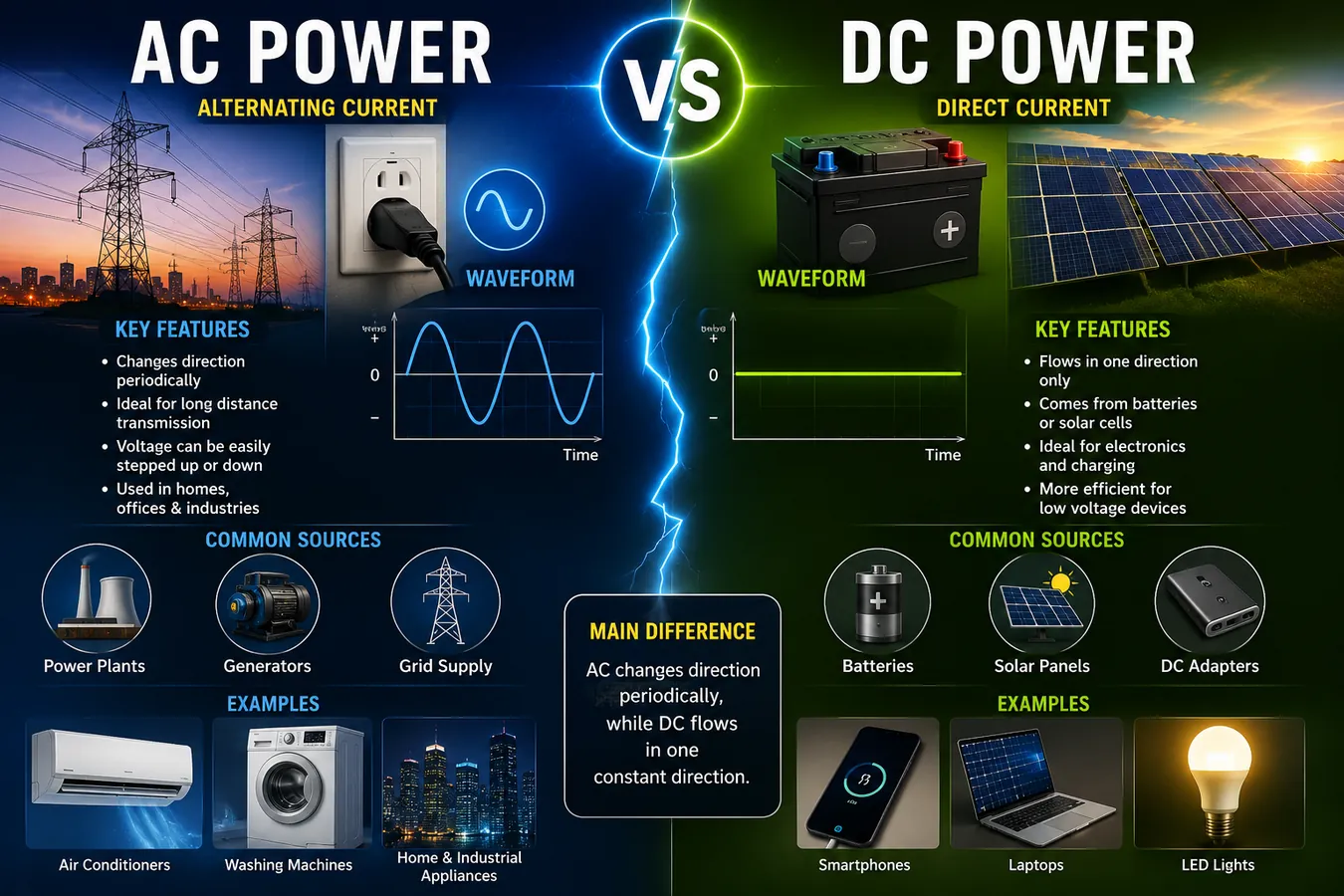
AC vs DC Power: The Complete Engineering Guide
Every outlet, battery, solar panel, and motor in your life runs on one of two current types. This guide breaks down how Alternating Current (AC) and Direct Current (DC) actually work, why the grid uses one and your phone uses the other, and how to choose the right generator, inverter, or battery system for your home or project.
Introduction
Nearly every electrical device you own depends on one of two fundamentally different ways of moving electrons: Alternating Current (AC) or Direct Current (DC). The power company sends AC into your home. Your phone, laptop, solar panels, and car battery all run on DC. Somewhere between the wall outlet and your devices, a transformer, rectifier, or inverter is quietly converting one into the other, often several times over.
Understanding AC vs DC power isn't just trivia for electricians and engineers. If you're sizing a solar system, choosing a backup generator, wiring a workshop, buying an inverter for your RV, or simply trying to understand your electric bill, the distinction between AC and DC determines which equipment you need, how efficient your system will be, and how to keep it safe. This guide walks through the physics, the history, the hardware, and the practical decisions — from the 1880s "War of Currents" to the HVDC transmission lines and EV batteries shaping the grid of the 2020s.
What Is Electricity?
Electricity is the movement of electric charge, almost always carried by electrons flowing through a conductor such as copper wire. Four properties describe that flow, and you'll see them throughout this guide:
Voltage (V)
The electrical "pressure" that pushes charge through a circuit, measured in volts.
Current (I)
The rate of charge flow, measured in amperes (amps).
Resistance (R)
Opposition to current flow, measured in ohms, which generates heat and power loss.
Power (P)
The rate of energy transfer, measured in watts, calculated as P = V × I.
What separates AC from DC is not any of these quantities individually, but the direction the current flows. In DC, electrons move in one constant direction. In AC, they periodically reverse direction, oscillating back and forth many times per second.
What Is Alternating Current (AC)?
Alternating Current is electricity that periodically reverses direction, tracing a smooth sine wave as voltage rises to a positive peak, falls through zero, drops to a negative peak, and rises again. In the United States this cycle repeats 60 times per second (60Hz); in the UK, Australia, and most of the world it repeats 50 times per second (50Hz).
AC is the power that comes out of your wall outlets. It's generated by rotating alternators in power plants, and its defining engineering advantage is that transformers can step its voltage up or down almost losslessly, which makes it the practical choice for transmitting electricity over long distances.
What Is Direct Current (DC)?
Direct Current flows in a single, constant direction, from the positive terminal of a source, through a circuit, back to the negative terminal. Plotted on a graph, ideal DC voltage looks like a flat, unwavering line rather than a wave.
Batteries, solar panels, fuel cells, and USB power banks all produce DC natively. So does every microchip inside your electronics — a laptop's processor, a phone's battery, and an LED's driver circuit all operate on DC internally, which is why AC-powered devices contain a power adapter to convert incoming AC into usable DC.
History of AC vs DC: The War of Currents
In the 1880s, Thomas Edison had already built DC generating stations in New York and championed direct current as the standard for America's electrical future. But DC voltage could not be efficiently transformed, which meant power plants had to sit within roughly a mile of the customers they served — impractical for lighting an entire country.
George Westinghouse, backed by Nikola Tesla's polyphase AC motor and transformer patents, pushed alternating current instead, because AC voltage could be stepped up for efficient long-distance transmission and stepped back down for safe household use. The rivalry, later nicknamed the "War of Currents," included public demonstrations, competing patents, and a bitter marketing battle. It was largely settled by 1893, when Westinghouse won the contract to light the World's Columbian Exposition in Chicago with AC, and again in 1895, when the Adams Power Station at Niagara Falls proved AC could transmit hydroelectric power over long distances at scale.
AC became the backbone of the world's electrical grids for the next century. Ironically, modern power electronics have brought DC back into prominence: high-voltage DC (HVDC) lines now move bulk power more efficiently than AC over very long distances, and the explosion of solar power, batteries, and electric vehicles means DC is once again central to how the grid is evolving.
How AC Power Works
AC power begins at a generating station, where a turbine — spun by steam, falling water, or wind — rotates a magnet inside a coil of wire (or a coil inside a magnetic field). This rotation induces a voltage that rises and falls sinusoidally as the magnetic field's angle relative to the coil changes, producing the alternating polarity that defines AC.
Frequency: 50Hz vs 60Hz
The United States, Canada, and much of the Americas standardized on 60Hz, while the UK, Europe, Australia, and most of Asia and Africa use 50Hz. Both are arbitrary historical choices tied to early generator designs; neither is inherently "better," but the difference matters when importing appliances or generators across regions, since motors and transformers are tuned to a specific frequency.
Voltage Transformation and Long-Distance Transmission
AC's defining advantage is the transformer: a simple device with no moving parts that uses electromagnetic induction to step voltage up or down with very little loss. Power plants generate electricity at a moderate voltage, step it up to hundreds of thousands of volts for transmission (lower current at high voltage means dramatically lower resistive losses over long distances), then step it back down through substations and neighborhood transformers until it reaches your home at a safe 120V (US) or 230V (UK/AU).
From Generation to Your Outlet
Generation → step-up transformer → high-voltage transmission lines → step-down substation → local distribution lines → neighborhood transformer → household wiring → your outlet. Industrial facilities often tap into the distribution grid at a higher voltage than homes, since large motors and equipment run more efficiently at higher voltages and three-phase AC.
How DC Power Works
DC power sources maintain a constant polarity and, ideally, a constant voltage. A battery's chemical reactions push electrons from its negative terminal through the external circuit to the positive terminal; a solar cell uses the photovoltaic effect to knock electrons loose when sunlight strikes a semiconductor, producing a steady DC output whenever light is available.
Batteries and Solar Panels
Lead-acid, lithium-ion, and other battery chemistries all store and release energy as DC. Solar panels are wired in series and parallel strings to produce a combined DC voltage and current, which is either used directly, stored in a battery bank, or converted to AC by an inverter for grid-tied use.
Electronic Circuits and Electric Vehicles
Every digital circuit — from a microcontroller to a graphics card — operates on stable low-voltage DC, because transistors and logic gates need a constant reference voltage to switch reliably. Electric vehicles store energy in large DC battery packs and use power electronics (inverters and motor controllers) to convert that DC into the AC that drives their electric motors, then convert AC generated during regenerative braking back into DC to recharge the battery.
Portable Electronics
Phones, laptops, cameras, and power banks all run on DC. Their "chargers" are really small AC-to-DC converters, stepping down and rectifying wall AC into the low-voltage DC these devices actually use.
Electrical Waveforms Explained
A waveform is simply a graph of voltage (or current) over time. Understanding the shape tells you almost everything about how a power source behaves.
Frequency, Voltage, Current, Power, Resistance
Frequency (measured in hertz) describes how many complete AC cycles occur per second — irrelevant to pure DC, since DC has no cycle. Voltage and current behave the same way conceptually in both systems, but AC values are usually expressed as RMS (root-mean-square), an effective average that lets you compare AC power to DC power on equal footing. Power in DC is simply P = V × I; in AC, "real power" (watts) can differ from "apparent power" (volt-amps) due to reactive loads like motors and transformers, a concept known as power factor. Resistance causes voltage drop and heat in both systems, but AC circuits also experience reactance from inductors and capacitors, which DC circuits do not.
Efficiency and Power Loss
Power lost to resistance in a wire is proportional to the square of the current (P = I²R). This is exactly why AC's ability to transform voltage matters so much: by raising voltage and lowering current for transmission, utilities cut resistive losses dramatically compared to sending the same power at low voltage and high current.
Power Sources: AC vs DC
AC Sources
Power stations, portable generators, alternators, hydroelectric plants, wind turbines, gas generators, diesel generators.
DC Sources
Batteries, solar panels, fuel cells, DC generators, USB power, power banks.
Key Components: Transformers, Rectifiers, Inverters & More
| Component | Function |
|---|---|
| Transformer | Steps AC voltage up or down using electromagnetic induction; cannot work on pure DC. |
| Rectifier | Converts AC into DC, typically using diodes. |
| Inverter | Converts DC into AC, used in solar systems, UPS units, and EVs. |
| Converter | General term for changing voltage/current characteristics; often DC-to-DC. |
| Alternator | A rotating generator that produces AC, common in vehicles and power plants. |
| Generator | Broad term for any device converting mechanical energy into electrical energy. |
| Battery | Stores chemical energy and releases it as DC. |
| Capacitor | Stores energy in an electric field; smooths voltage ripple in both AC and DC circuits. |
| Diode | Allows current to flow in one direction only; the building block of rectifiers. |
| Motor | Converts electrical energy into mechanical motion; available in both AC and DC designs. |
| Circuit Breaker | Automatically interrupts current flow during an overload or fault. |
| Fuse | A sacrificial component that melts to break a circuit during overcurrent, protecting wiring and devices. |
Applications: Where AC and DC Are Used
AC Applications
Homes, factories, commercial buildings, HVAC systems, large industrial motors, and grid transmission.
DC Applications
Solar systems, electric vehicles, computers, phones, LED lighting, telecommunications equipment, marine systems, and aircraft.
Advantages and Disadvantages
Advantages of AC
Efficient long-distance transmission, easy voltage transformation via transformers, lower transmission losses at high voltage, wide availability through the existing grid, native grid compatibility, and strong performance driving large industrial motors and equipment.
Disadvantages of AC
Higher perceived shock risk due to the way alternating current interacts with the human body, reactive power that reduces effective efficiency in inductive loads, the need for generators to stay synchronized in frequency and phase, and more complex electronics required to convert it for sensitive devices.
Advantages of DC
Straightforward battery storage, natural compatibility with solar panels, high efficiency in modern electronics, a stable constant voltage, strong fit for electric vehicles, natural pairing with renewable energy systems, and lower conversion losses when powering DC-native electronics directly.
Disadvantages of DC
Historically difficult and costly voltage conversion (though modern DC-DC converters have improved this significantly), higher transmission cost over very long distances at low voltage, ongoing battery maintenance and degradation, and limited legacy infrastructure for direct DC distribution in most homes.
AC vs DC Comparison Table
| Category | AC (Alternating Current) | DC (Direct Current) |
|---|---|---|
| Current direction | Reverses periodically | Flows in one constant direction |
| Waveform | Sine wave | Flat line |
| Frequency | 50Hz or 60Hz | None (0Hz) |
| Voltage | Easily transformed up/down | Requires DC-DC converters |
| Power transmission | Efficient over medium distances via transformers | Efficient over very long distances via HVDC |
| Efficiency | High with proper transformation; some reactive losses | High for short-range and electronics; conversion losses at scale |
| Safety perception | Higher shock risk at household voltages | Considered comparatively safer at low voltage, but high-voltage DC is equally hazardous |
| Battery compatibility | Requires rectification to charge batteries | Native compatibility |
| Generators | Standard alternators / generator sets | DC generators, solar panels, fuel cells |
| Motors | Induction and synchronous motors, common in industry | Brushed/brushless DC motors, common in EVs and electronics |
| Electronics | Needs conversion before use internally | Native power source for circuits |
| Renewable energy | Wind turbines generate AC | Solar panels generate DC natively |
| Electric vehicles | Used for motor drive after inversion | Native battery storage |
| Home appliances | Standard household power | Used internally after conversion |
| Industrial machinery | Dominant for large motors and heavy equipment | Used in automation, controls, and DC drives |
| Maintenance | Mature, widely serviced infrastructure | Batteries require monitoring and periodic replacement |
| Cost | Lower cost at grid scale due to mature infrastructure | Higher cost for large-scale long-distance transmission hardware |
AC vs DC in Solar Systems
Solar panels produce DC electricity directly from sunlight. In a grid-tied system, that DC power flows to a solar inverter, which converts it into clean AC synchronized with the utility grid's voltage and frequency so it can power your home or export excess energy back to the grid.
In systems with battery storage, DC from the panels can charge batteries directly (often through a charge controller), and a separate inverter converts stored DC into AC when needed. Off-grid systems skip the utility connection entirely, relying on solar panels, batteries, and an inverter to supply all household AC loads independently. Hybrid systems combine both: grid-tied for normal operation, with battery backup for outages.
AC vs DC in Generators
Most portable and standby generators use an alternator to produce AC directly, mechanically driven by a gasoline, diesel, or propane engine. Traditional generators regulate output by controlling engine RPM to hold a steady 50Hz or 60Hz frequency, which can cause voltage fluctuations under changing load.
Inverter generators take a different approach: they first generate raw AC, convert it to DC, then use solid-state electronics to invert it back into extremely clean, stable AC regardless of engine speed. This produces a cleaner sine wave safer for sensitive electronics like laptops and medical equipment, and allows the engine to run only as fast as needed, improving fuel efficiency and reducing noise.
True DC generators exist for specialized applications (such as battery charging or industrial DC drives) but are far less common than AC alternator-based designs for general power generation.
Home Applications
A typical home mixes both current types constantly. AC directly powers lighting circuits, kitchen appliances, air conditioners, refrigerator compressors, and power tools. Meanwhile, computers, routers, TVs, and charging stations all convert incoming AC to DC internally or via external adapters before the electronics can use it.
Industrial Applications
Manufacturing plants rely heavily on three-phase AC to run large motors, conveyor systems, and automation equipment efficiently. Variable frequency drives (VFDs) convert incoming AC to DC and back to precisely controlled AC to adjust motor speed and torque. Data centers, by contrast, are shifting toward DC power distribution internally to reduce conversion losses across the many AC-DC-AC steps otherwise required to run servers. Mining, oil and gas, and construction sites typically depend on diesel or gas AC generators for portable power in the field.
Safety: Working Safely with AC and DC
Electrical shock occurs when current flows through the body, and the severity depends on voltage, current path, duration, and the body's resistance. Proper grounding gives fault current a safe path back to earth instead of through a person. Circuit breakers and fuses provide overcurrent protection by interrupting a circuit before wiring overheats or a fault escalates into a fire.
| Safety Topic | Why It Matters |
|---|---|
| Lockout/Tagout | Prevents equipment from being energized unexpectedly during maintenance. |
| Battery safety | Prevents short circuits, thermal runaway, and acid or chemical exposure. |
| Generator safety | Avoids carbon monoxide buildup and backfeeding the grid without a transfer switch. |
| Solar safety | DC arcs from solar panels can persist and are harder to extinguish than AC arcs. |
| Fire prevention | Loose connections and undersized wiring are leading causes of electrical fires. |
| Code compliance | Following the National Electrical Code (NEC) or local equivalent ensures safe, inspected installations. |
Common Misconceptions
"AC is always dangerous"
Danger depends on voltage and current, not current type alone; low-voltage AC (like some doorbell circuits) is quite safe.
"DC cannot power homes"
DC microgrids and DC appliances exist; the grid uses AC mainly for historical and transmission-efficiency reasons, not because DC is impossible at home scale.
"Solar panels produce AC"
Solar panels generate DC; an inverter is required to produce AC for the grid or home.
"Batteries produce AC"
Batteries store and release DC exclusively; any AC output requires an inverter.
"AC is always more efficient"
AC is more efficient for medium-distance grid transmission, but DC-native electronics often lose less energy than AC-DC conversion chains.
"DC cannot travel long distances"
Modern HVDC lines transmit power efficiently over hundreds or thousands of miles with lower losses than equivalent AC lines at extreme distances.
The Future of AC and DC
The grid is quietly becoming more DC-centric even as AC remains its backbone. HVDC transmission lines now move bulk power across continents and undersea cables with lower losses than AC over extreme distances. Smart grids increasingly manage a mix of AC distribution and DC-native resources like solar, batteries, and EVs in real time. Electric vehicles and stationary battery storage are pushing utilities and manufacturers to rethink DC fast-charging infrastructure. Microgrids and hybrid AC/DC systems — especially in remote or renewable-heavy areas — are reducing the number of conversion steps between generation and end use, improving overall system efficiency.
Buyer's Guide: Choosing the Right Equipment
Inverter
Match continuous and surge wattage to your loads; choose pure sine wave for sensitive electronics.
Generator
Size for starting (surge) wattage of your largest appliance, not just running wattage; consider inverter generators for clean power.
Battery
Compare usable capacity, depth of discharge, cycle life, and chemistry (lithium vs lead-acid) for your budget and use case.
Transformer
Match voltage, phase, and frequency ratings exactly to your equipment and region.
Solar equipment
Size panels, charge controller, and inverter together as a matched system rather than individually.
Power supplies
Check output voltage, current rating, and regulation quality for the specific device you're powering.
Discussion
No comments yet. Be the first to join the conversation!