
What Is Voltage?
A complete guide to electrical potential difference — what it means, how it's measured, and how it drives everything from a AA battery to a household circuit.
What Is Voltage? Definition, Meaning, and Basic Concept
Voltage is the electrical potential difference between two points in a circuit. In the simplest terms, voltage is what pushes electric charge to move — it's the "electrical pressure" that drives current through a wire, a resistor, a motor, or any other electrical load. That pressure analogy is helpful for beginners, but it's worth being precise from the start: voltage isn't literally pressure in a physical sense. It's a measure of energy per unit of charge, and it only makes sense when you're comparing two points. You can't measure "the voltage" at a single, isolated point in space any more than you can measure "the height" of a single point without reference to sea level or the ground. Voltage always describes a difference — between a battery's positive and negative terminals, between a wire and the earth, or between the input and output of a component.
The unit of voltage is the volt, abbreviated V, named after the Italian physicist Alessandro Volta. You'll see voltage ratings everywhere in daily life: a AA battery is rated at 1.5 V, a USB port supplies 5 V, a car's electrical system runs on 12 V, industrial control systems often use 24 V, and household wall outlets are commonly rated at 120 V in North America or 230 V across much of Europe, Asia, and Africa. Large industrial and utility systems use much higher voltages — thousands or even hundreds of thousands of volts — for reasons we'll get into later.
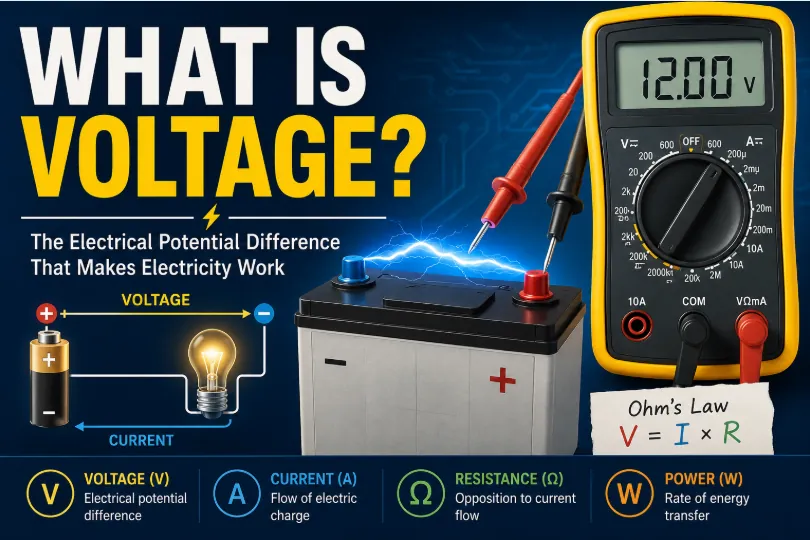
Voltage doesn't act alone. It works together with current (the rate at which charge flows, measured in amperes) and resistance (the opposition to that flow, measured in ohms) to determine how much power a circuit delivers or consumes. A simple way to picture this is a battery connected to a light bulb through a switch. When the switch closes, the battery's voltage pushes charge through the filament of the bulb. The bulb resists that flow to some degree, which is exactly why it heats up and glows. Turn the battery around, or swap a stronger battery in, and the brightness changes — a direct, visible demonstration of voltage doing work.
It's common for beginners to mix up voltage, current, and power, so it's worth stating the distinction plainly: voltage is the potential difference that can cause charge to move, current is the actual flow of that charge, and power is the rate at which energy is being transferred or converted (light, heat, motion, and so on). Voltage can exist without current flowing — think of an unconnected battery sitting in a drawer — but current cannot flow without some voltage present to drive it.
In DC (direct current) circuits, batteries and other sources have a positive terminal and a negative terminal. This polarity isn't arbitrary — it determines the direction of conventional current flow, from positive to negative through the external circuit. Understanding voltage, and how it relates to current, resistance, and power, is foundational for anyone working with batteries, inverters, generators, solar panels, motors, household wiring, or basically any electronic device.
Key concepts covered
- Voltage definition
- Electrical potential difference
- Volt (V)
- Voltage polarity
- Battery voltage
- Voltage vs current
- Voltage vs power
How Does Voltage Work? Electrical Potential Difference Explained
To really understand voltage, it helps to step back into the physics of electric charge and energy. Every electric charge sitting within an electric field has some amount of electric potential energy, and that amount depends on the charge's position within the field — similar to how an object at the top of a hill has more gravitational potential energy than the same object at the bottom. Voltage is essentially a way of expressing that potential energy on a per-charge basis: it tells you how much energy each unit of charge would gain or lose moving between two points.
Applying that idea to something familiar: a 9 V battery, under the idealized definition, can supply roughly 9 joules of energy for every coulomb of charge that flows through a connected circuit. That energy doesn't come from nowhere — inside the battery, chemical reactions physically separate positive and negative charges, building up a difference in potential energy between the two terminals.
Generators work on a different principle to reach the same result. Instead of chemical reactions, a generator uses electromagnetic induction — a conductor moving through a magnetic field (or vice versa) — to convert mechanical energy into electrical energy. Spinning a coil within a magnetic field forces charges within the conductor to separate, generating a voltage across the generator's terminals.
This is part of why measuring voltage with a multimeter is fundamentally different from measuring current: a voltmeter is connected across two points (in parallel) without needing to break the circuit, while measuring current typically requires inserting the meter directly into the current's path (in series). Voltage differences are the practical manifestation of an underlying electric field, which is what actually exerts force on charges once a conductive path exists. As current flows through a circuit's components, some of the source voltage is "used up" — this is called voltage drop, and it happens even in the wires themselves.
Key concepts covered
- Electric potential energy
- Joules per coulomb
- Electric field
- Battery voltage generation
- Generator voltage generation
- Open-circuit voltage
- Voltage drop
Types of Voltage: DC, AC, Peak, RMS, and Nominal Voltage
DC voltage (direct current voltage) is voltage whose polarity stays generally fixed — the positive terminal stays positive and the negative terminal stays negative, even if the magnitude fluctuates somewhat. Batteries, solar panels, USB power supplies, and most DC power adapters all produce DC voltage.
AC voltage (alternating current voltage), by contrast, changes both magnitude and polarity periodically, typically following a sine-wave pattern. Household electricity is AC precisely because this alternating behavior makes it far easier to generate, transform between voltage levels, and transmit efficiently over long distances — rising, falling, and reversing direction 50 or 60 times per second in most systems worldwide.
Describing an AC waveform
Because AC voltage is constantly changing, describing "the voltage" of an AC source requires more nuance than a single number:
- Instantaneous voltage — the voltage at one specific moment in time
- Peak voltage — the maximum value the waveform reaches
- Peak-to-peak voltage — the total swing from most positive to most negative
- Average voltage — the average over a full cycle (technically zero for a symmetric sine wave)
- RMS voltage — an equivalent value representing effective power-producing capability, as if it were steady DC
RMS voltage is the figure that actually matters for calculating power delivered to resistive loads, which is why manufacturers and utilities quote it. A supply labeled around 230 V AC refers to its RMS value — the instantaneous peak is actually notably higher, closer to 325 V.
You'll also run into nominal voltage — the labeled or rated voltage of a device, used as a convenient reference rather than an exact real-time reading. A "12 V battery" might actually measure anywhere from about 11.8 V to nearly 13 V or higher depending on state of charge, temperature, age, and load. This is completely normal.
Key concepts covered
- DC voltage
- AC voltage
- Peak voltage
- Peak-to-peak voltage
- RMS voltage
- Nominal voltage
- 12V / 24V / 48V systems
- 120V / 230V AC
Voltage, Current, Resistance, and Power: How They Are Related
The foundational relationship is Ohm's Law:
where V is voltage (volts), I is current (amperes), and R is resistance (ohms). If resistance stays constant and voltage increases, current increases proportionally. If voltage stays constant and resistance increases, current decreases.
Alongside Ohm's Law, electrical power is described by:
Power, measured in watts, tells you the rate at which electrical energy is being converted. As an example:
This relationship also explains a very practical engineering decision: for a fixed amount of power, increasing the voltage allows the same power to be delivered with less current — and less current means less energy lost to resistive heating in the wires. This is a major reason long-distance electrical transmission systems use very high voltages.
Combining Ohm's Law with the power equation gives two more useful forms:
These are especially useful for understanding heating effects in resistive components — a heating element, a bulb filament, or an overloaded wire all follow these relationships, which is part of why undersized wiring can overheat.
Key concepts covered
- Ohm's Law
- V = IR
- P = VI
- P = I²R
- P = V²/R
- Voltage drop
- Wire losses
- Electrical power
How to Measure Voltage With a Multimeter
A voltmeter (or a multimeter set to voltage mode) measures the potential difference between two points, and it must be connected in parallel with the component or source being measured — meaning the two probes touch the two points you want to compare, without needing to break the circuit open.
Before measuring, choose the correct mode: DC voltage for batteries, solar panels, and most electronic power supplies, or AC voltage for household outlets and mains-connected equipment.
Multimeters come in two general styles: manual-ranging, where you select the expected voltage range yourself, and auto-ranging, where the meter automatically detects the appropriate range.
Common mistakes to avoid
- Leaving the meter set to current mode when trying to measure voltage
- Connecting probes to the wrong terminals or points
- Touching exposed conductors, especially near mains voltage
- Attempting a measurement beyond the meter's rated safety category (CAT rating)
Voltage readings also change depending on load. No-load voltage is what you measure with nothing drawing current, while loaded voltage reflects the voltage once current is actually flowing — typically somewhat lower. Comparing the two is a useful diagnostic technique for a weak or failing battery. Measuring household or industrial AC power requires appropriate knowledge and a correctly rated meter — never assume a low-cost or unrated meter is safe on high-energy systems.
Key concepts covered
- Digital multimeter
- Measuring DC voltage
- Measuring AC voltage
- Auto-ranging vs manual
- No-load voltage
- Loaded voltage
- Measurement safety
Voltage in Batteries, Inverters, Generators, Solar Panels, Motors, and Home Electrical Systems
Batteries are rated at familiar nominal voltages — 1.5 V for common alkaline cells, 3.7 V for lithium-ion cells, and 12 V, 24 V, or 48 V for larger battery banks. Actual measured voltage varies with chemistry, state of charge, temperature, and load.
Inverters are built around the relationship between a DC input and an AC output. A typical off-grid or backup inverter takes DC power from a 12 V or 24 V battery system and converts it into AC voltage suitable for household appliances. Matching an inverter's rated DC input voltage to your battery system's voltage is critical.
Generators produce voltage through electromagnetic induction. Rotational speed, magnetic field strength, winding characteristics, and load all influence the voltage produced — part of why voltage regulators are built into most generators.
Solar panels have their own key voltage characteristics: open-circuit voltage (no load connected) and operating voltage (under actual load, at the panel's maximum power point). Panels are commonly wired in series to increase total voltage, or in parallel to increase total current.
Motors have a rated voltage that matters a great deal for correct operation — applying voltage significantly different from a motor's rating can lead to poor performance, overheating, excess current draw, or damage.
Household electrical systems likewise depend on matching appliance nameplate voltage to the supply voltage. A device rated for 120 V AC generally shouldn't be connected to a 230 V AC supply without an appropriate converter, and vice versa.
Key concepts covered
- Battery voltage
- Inverter voltage
- Generator voltage
- Solar panel voltage
- Motor rated voltage
- Open-circuit voltage
- Series & parallel wiring
- Voltage compatibility
Why Voltage Matters, Common Voltage Mistakes, FAQs, and Final Summary
Understanding voltage isn't just an academic exercise — it directly affects electrical safety, equipment selection, troubleshooting accuracy, and the reliability of any power system you build or maintain.
Common voltage mistakes include: assuming voltage and current are interchangeable, assuming a battery will always output exactly its nominal voltage, confusing AC RMS voltage with peak voltage, connecting equipment to an incompatible voltage source, ignoring voltage drop over long wire runs, and measuring mains electricity without appropriate knowledge and equipment.
Both overvoltage and undervoltage create real problems — overvoltage can stress or destroy sensitive components, while undervoltage can cause motors to draw excess current while struggling to produce rated torque. This is where voltage regulation becomes important: regulated power supplies and generators use feedback circuitry to maintain a relatively stable output voltage. Many electronic devices also specify a voltage tolerance — an acceptable input range.
Frequently asked questions
What is voltage?
Voltage is the electrical potential difference between two points, representing the energy per unit of charge available to drive current through a circuit.
What is the unit of voltage?
The volt (V).
Is voltage the same as current?
No. Voltage is the potential difference driving charge to move; current is the actual rate of charge flow.
What is the difference between AC and DC voltage?
DC voltage maintains generally fixed polarity, while AC voltage periodically changes magnitude and polarity, typically in a sine-wave pattern.
How is voltage measured?
With a voltmeter or multimeter set to voltage mode, connected in parallel across the two points being measured.
Why does voltage drop occur?
Because every real component and wire has some resistance, and current flowing through that resistance consumes part of the source voltage.
What is RMS voltage?
An equivalent value for AC voltage representing its effective power-producing capability, comparable to a steady DC voltage of the same value.
What is nominal voltage?
The labeled or rated voltage of a device or system, used as a convenient reference even though actual measured voltage varies somewhat in practice.
Can voltage exist without current?
Yes — an open, disconnected circuit (like an unconnected battery) still has voltage across its terminals, but no current flows until a path is completed.
Why is high voltage used for power transmission?
Because for a given amount of power, higher voltage means lower current, which reduces resistive losses in transmission wires over long distances.
Final summary
Voltage is the electrical potential difference that provides the energy-per-unit-charge relationship enabling electrical systems to function — from the simplest battery-and-bulb circuit to national power grids. It works alongside current, resistance, and power to determine how electrical energy is generated, transmitted, and used. Whether you're working with batteries, generators, solar panels, inverters, motors, or household appliances, a solid grasp of voltage is essential for safe, effective electrical work.
Related calculators
Put the numbers from this guide to work — every calculator below is free and runs instantly in your browser.
Discussion
No comments yet. Be the first to join the conversation!