
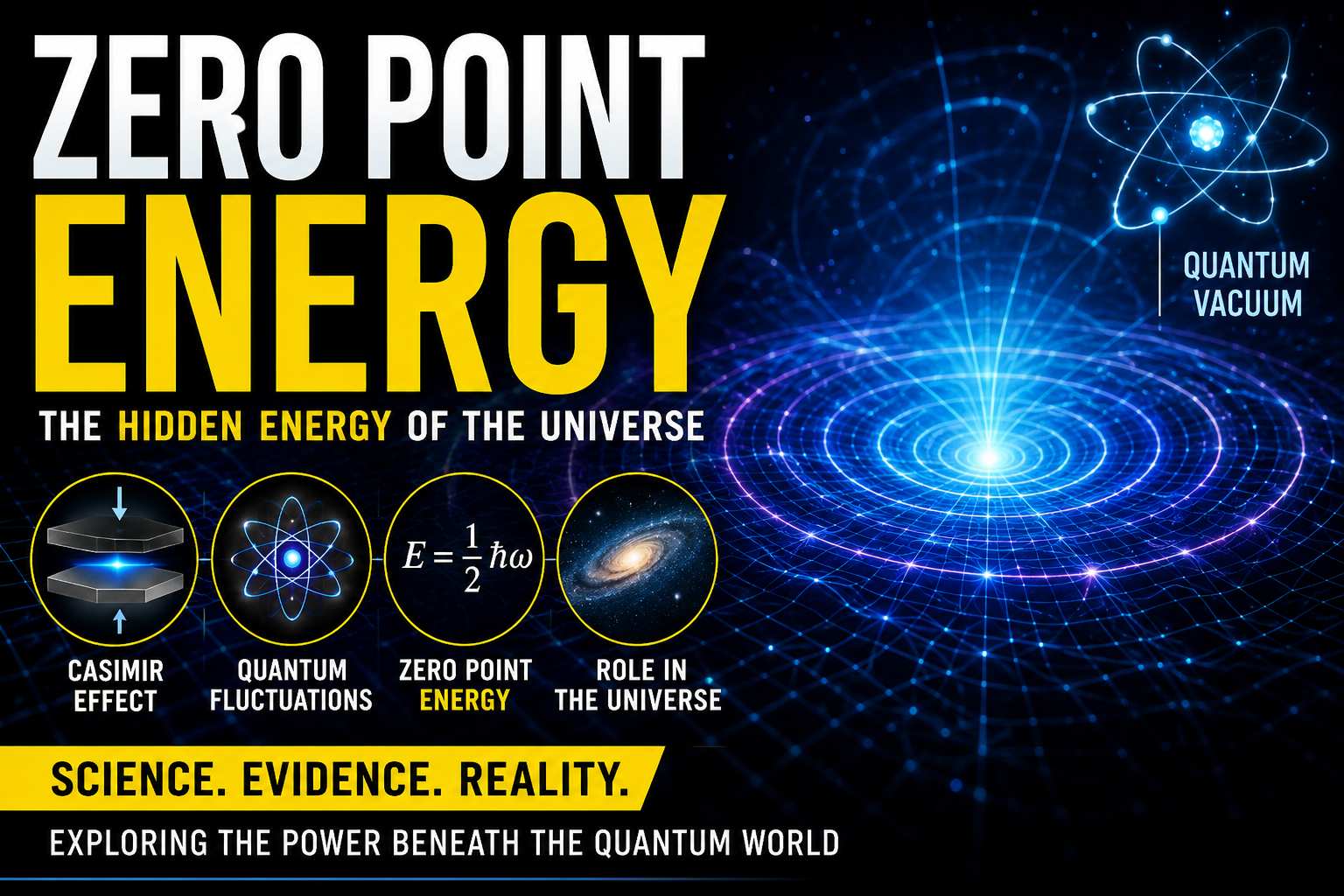
What Is Zero Point Energy?
Zero Point Energy (ZPE) is a concept from quantum physics that describes the lowest possible energy state of a physical system. Unlike classical physics, where a system at absolute zero temperature would contain no motion or energy, quantum mechanics predicts that particles continue to exhibit tiny fluctuations even at absolute zero. These fluctuations arise from the uncertainty principle, which states that the position and momentum of particles cannot both be known with perfect precision at the same time. As a result, particles can never be completely at rest. The residual energy that remains in a system at its ground state is known as zero point energy. This phenomenon has been observed in numerous quantum systems and is considered a fundamental aspect of modern physics. Scientists use the concept of ZPE to explain behaviors in atomic structures, molecular vibrations, and quantum fields. Although the term is often associated with speculative energy-generation claims, in scientific literature it refers specifically to measurable quantum effects that exist even in the absence of thermal energy.
The Quantum Origins of Zero Point Energy
The idea of zero point energy emerged during the development of quantum theory in the early twentieth century. Researchers discovered that atoms and molecules do not behave according to classical mechanics when examined at very small scales. One of the earliest examples of ZPE can be found in the quantum harmonic oscillator, a model used to describe vibrating particles. Classical physics predicts that the oscillator can come to a complete stop, but quantum mechanics shows that it always retains a minimum amount of energy. This minimum energy is the oscillator's zero point energy. The concept was later extended to electromagnetic fields, leading to the understanding that even empty space contains fluctuating quantum fields. These fluctuations arise because particles and antiparticles can momentarily appear and disappear in accordance with quantum laws. The vacuum of space is therefore not truly empty but contains a background level of energy associated with these fluctuations. Quantum electrodynamics, one of the most successful scientific theories ever developed, incorporates these vacuum effects and accurately predicts experimental results. The existence of ZPE is now widely accepted within mainstream physics and forms an essential part of our understanding of the quantum world.
Experimental Evidence for Zero Point Energy
Although zero point energy itself cannot be directly extracted in a straightforward manner, its effects have been observed through several well-documented experiments. One of the most famous examples is the Casimir Effect. In this phenomenon, two uncharged metal plates placed extremely close together experience an attractive force due to changes in the quantum vacuum between them. The effect was predicted by Dutch physicist Hendrik Casimir in 1948 and has since been confirmed by numerous laboratory measurements. Another important example is the Lamb Shift, a small change in the energy levels of hydrogen atoms that results from interactions with vacuum fluctuations. Theoretical predictions and experimental observations of the Lamb Shift match with remarkable accuracy, providing strong evidence for the reality of quantum vacuum effects. Zero point motion is also observed in liquid helium, which remains fluid at temperatures near absolute zero because quantum fluctuations prevent the atoms from completely freezing under normal pressure conditions. These and other experiments demonstrate that quantum vacuum energy is not merely a mathematical concept but has measurable physical consequences. However, the observed effects do not imply that unlimited usable energy can be obtained from the vacuum.
Zero Point Energy in Modern Physics
Today, zero point energy plays an important role in several areas of theoretical and experimental physics. In quantum field theory, every field has a ground-state energy associated with vacuum fluctuations. These energies contribute to calculations involving particle interactions and electromagnetic phenomena. ZPE is also connected to cosmology through discussions of vacuum energy and the expansion of the universe. Some physicists believe that vacuum energy may be related to dark energy, the mysterious force that appears to be driving the accelerated expansion of the cosmos. However, the exact relationship remains one of the biggest unresolved questions in modern science. Researchers continue to investigate how quantum vacuum energy influences gravitational systems, black holes, and the early universe. Theoretical studies suggest that vacuum fluctuations may have played a role during cosmic inflation, a period of extremely rapid expansion shortly after the Big Bang. Despite decades of research, many aspects of vacuum energy remain poorly understood. Nevertheless, zero point energy remains an essential component of quantum theory and continues to inspire new scientific investigations into the fundamental nature of reality.
Claims About Free Energy and Scientific Reality
Zero point energy is frequently mentioned in discussions about free-energy devices, overunity machines, and unlimited power generators. Many websites, videos, and inventors claim to have developed systems capable of extracting vast amounts of energy from the quantum vacuum. However, no such device has ever been independently verified by the scientific community. According to current physical laws, particularly the principles of thermodynamics and energy conservation, there is no proven method for continuously extracting usable energy from vacuum fluctuations without expending an equivalent amount of energy elsewhere. Scientists carefully distinguish between the existence of zero point energy and claims that it can be harvested as a limitless power source. While vacuum energy produces measurable effects such as the Casimir force, these effects do not provide evidence that practical energy-generation systems can be built from them. Peer-reviewed research has not demonstrated a reproducible technology capable of generating net power from the quantum vacuum. Therefore, while ZPE is a real scientific phenomenon, many popular claims surrounding zero point energy generators remain unsupported by experimental evidence. Understanding this distinction is essential for separating established physics from speculation.
Future Research and the Importance of Zero Point Energy
The study of zero point energy continues to be a significant area of scientific research because it touches upon some of the deepest questions in physics. Scientists are exploring how vacuum fluctuations interact with gravity, how they influence the structure of spacetime, and whether they can help explain dark energy and other cosmological mysteries. Advances in quantum technologies, including quantum computing, quantum sensors, and precision measurement systems, may provide new ways to investigate vacuum phenomena with unprecedented accuracy. Researchers are also studying quantum vacuum engineering, where carefully designed structures manipulate vacuum fluctuations for specialized technological applications. Although practical extraction of vacuum energy remains unproven, understanding ZPE has already contributed to numerous advances in physics and engineering. The concept has improved theoretical models, enhanced precision measurements, and expanded our knowledge of the microscopic universe. As experimental capabilities continue to improve, scientists may gain deeper insights into the nature of quantum vacuum energy and its role in the cosmos. For now, zero point energy remains one of the most fascinating and scientifically important concepts in quantum physics, representing both a confirmed physical reality and an ongoing frontier of research.
Conclusion
Zero point energy is a well-established concept in quantum mechanics that refers to the minimum energy present in a system even at absolute zero temperature. Its existence is supported by phenomena such as the Casimir Effect, the Lamb Shift, and zero point motion in quantum systems. Modern physics recognizes vacuum fluctuations as real and measurable, making ZPE an important part of quantum field theory and cosmology. However, there is currently no verified scientific evidence that zero point energy can be harvested as an unlimited source of practical power. While many claims about free-energy generators exist, they have not been validated through reproducible experiments or accepted scientific research. The true significance of zero point energy lies in its contribution to our understanding of the quantum universe and its potential to reveal deeper insights into the fundamental laws governing nature.
Frequently Asked Questions (FAQs) About Zero Point Energy
| No. | Question | Answer |
|---|---|---|
| 1 | What is Zero Point Energy (ZPE)? | Zero Point Energy is the minimum energy that remains in a quantum mechanical system even at absolute zero temperature. |
| 2 | Is Zero Point Energy a real scientific phenomenon? | Yes. Zero Point Energy is a well-established concept in quantum physics and is supported by experimental evidence such as the Casimir Effect and the Lamb Shift. |
| 3 | Does empty space contain energy? | According to quantum field theory, even empty space contains vacuum fluctuations and a small amount of background energy known as vacuum energy. |
| 4 | What causes Zero Point Energy? | Zero Point Energy arises from the quantum uncertainty principle, which prevents particles and fields from being completely motionless. |
| 5 | What is the Casimir Effect? | The Casimir Effect is a measurable force between two closely spaced metal plates caused by changes in quantum vacuum fluctuations between them. |
| 6 | Can Zero Point Energy be used to generate free electricity? | There is currently no scientifically verified technology capable of extracting unlimited usable electricity from Zero Point Energy. |
| 7 | Is Zero Point Energy related to dark energy? | Some physicists believe vacuum energy may be connected to dark energy, but the exact relationship remains an open question in cosmology. |
| 8 | Why is Zero Point Energy important in physics? | It helps explain atomic behavior, quantum field interactions, vacuum fluctuations, and several experimentally observed quantum phenomena. |
| 9 | Has any Zero Point Energy generator been proven to work? | No. To date, no Zero Point Energy generator has been independently verified by the scientific community to produce net usable power. |
| 10 | What is the future of Zero Point Energy research? | Scientists continue studying quantum vacuum effects, cosmology, and fundamental physics to better understand the role of Zero Point Energy in the universe. |
Discussion
No comments yet. Be the first to join the conversation!