
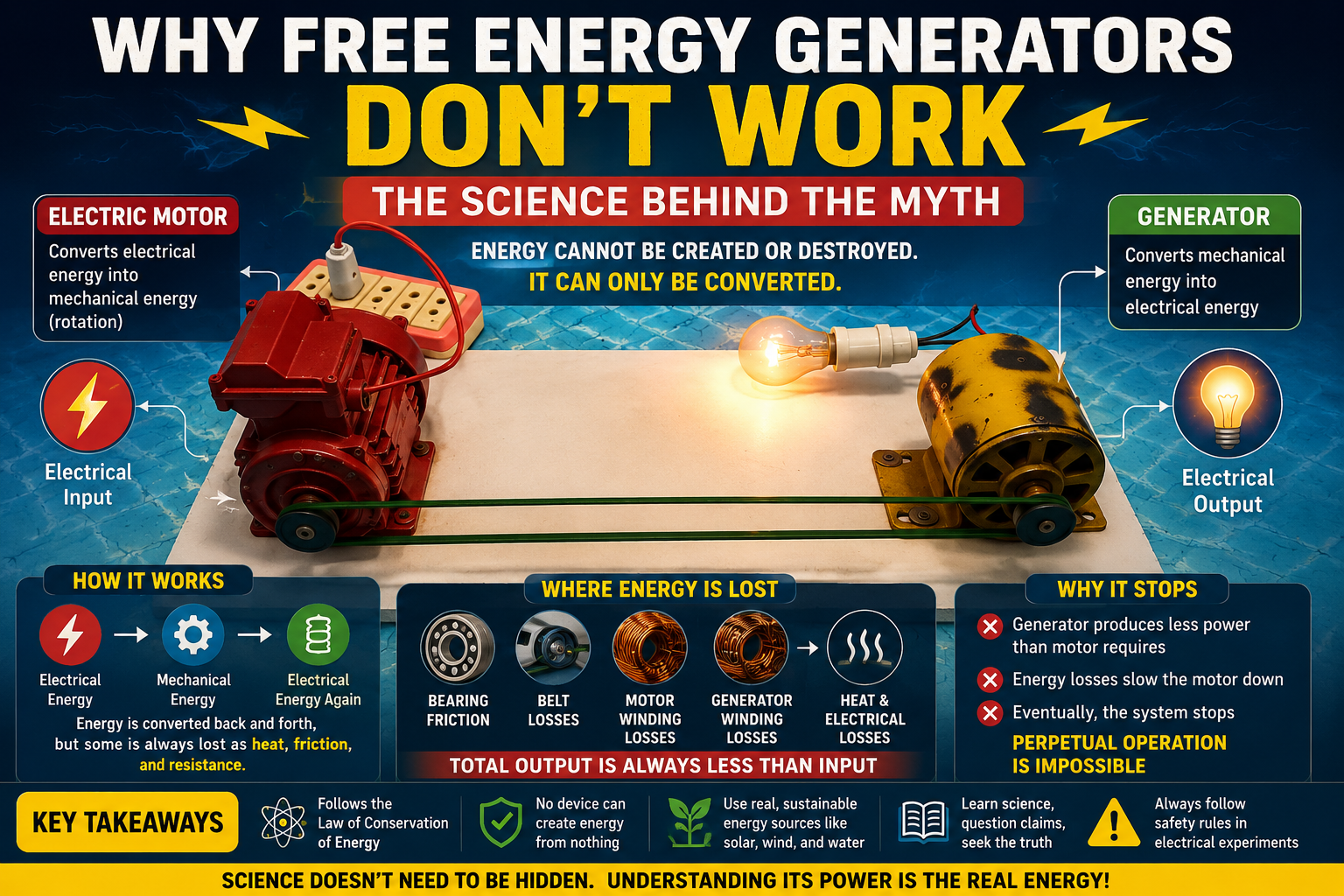
Why Free Energy Generators Don't Work: The Science Behind the Myth
Introduction to Free Energy Generators
The concept of a free energy generator has captured the imagination of people around the world for many years. These devices are often described as machines capable of producing electricity without requiring fuel, batteries, solar panels, wind power, or any other external energy source. According to many online claims, a free energy generator can continue operating indefinitely while producing enough electricity to power lights, appliances, and even entire homes. Such claims naturally attract attention because the idea of unlimited electricity without ongoing costs is incredibly appealing.
The popularity of free energy generators has grown significantly due to social media platforms, video-sharing websites, and online forums. Every day, millions of viewers watch videos showing motors, generators, magnets, and rotating machines that appear to generate electricity while running themselves. Many of these demonstrations are presented in a way that makes the systems look revolutionary and highly convincing. Bright lights, spinning motors, and seemingly self-powered devices often create the impression that the laws of physics have somehow been overcome.
One of the most common claims made by free energy enthusiasts is that these systems can produce more energy than they consume. Some videos suggest that a motor can drive a generator, which then produces enough electricity to power the motor and provide additional energy for external loads. Others claim that magnets alone can generate continuous power without any external input. These ideas are often promoted as hidden technologies that could solve the world's energy problems.
Many people believe these systems work because the demonstrations appear simple and visually convincing. However, appearances can be misleading. In reality, every generator requires an energy source, and no machine has ever been scientifically proven to create energy from nothing. Throughout this article, we will examine the science behind electricity generation, explore a real motor-generator experiment, and explain why free energy generators fail when tested under real-world conditions.
The Fundamental Laws of Energy
To understand why free energy generators do not work, it is important to first understand one of the most fundamental principles in physics: the Law of Conservation of Energy. This law states that energy cannot be created or destroyed. Instead, energy can only be transferred from one form to another. This principle has been tested and confirmed through countless scientific experiments and forms the foundation of modern physics and engineering.
Many free energy claims are based on the idea that a machine can somehow produce more energy than it consumes. However, this directly contradicts the conservation of energy. If a device were capable of creating energy from nothing, it would overturn one of the most established scientific laws ever discovered. Despite decades of investigation and experimentation, no machine has ever been proven to violate this law under controlled conditions.
A common misunderstanding arises from the difference between creating energy and converting energy. Real generators do not create electricity out of thin air. Instead, they convert mechanical energy into electrical energy. For example, a wind turbine converts the kinetic energy of moving air into electricity. A hydroelectric generator converts the energy of flowing water into electrical power. In both cases, the energy already exists and is simply being transformed into a different form.
We encounter energy conversion in everyday life. A car engine converts the chemical energy stored in fuel into motion. A light bulb converts electrical energy into light and heat. A fan converts electrical energy into mechanical movement. In each example, energy changes form, but no new energy is created.
These same principles apply to every generator ever built. Whether it is a small portable generator, a wind turbine, a hydroelectric station, or a large power plant, all generators require an external energy source. Without that input energy, electricity cannot be produced. This is why free energy generators remain impossible according to our current understanding of physics. Every successful generator in the world operates by converting existing energy, not by creating new energy.
Understanding Motors and Generators
Electric motors and generators are among the most important machines in modern technology. Although they perform opposite functions, they operate using closely related principles. Understanding how these devices work is essential for understanding why free energy generators cannot function as claimed.
An electric motor is designed to convert electrical energy into mechanical energy. When electricity flows through the motor's windings, it creates magnetic fields that interact with permanent magnets or other electromagnetic components inside the motor. These magnetic forces cause the rotor to spin, producing rotational motion. This mechanical rotation can then be used to drive fans, pumps, conveyor systems, power tools, and countless other machines. In simple terms, a motor takes electrical power from a source and transforms it into useful movement.
A generator works in the opposite direction. Instead of using electricity to create motion, it uses motion to create electricity. Inside a generator, magnets rotate past coils of wire, creating a changing magnetic field. According to the principle of electromagnetic induction, this changing magnetic field produces an electrical current in the wire coils. The faster the generator rotates, the greater the electrical output it can produce. This is why generators require an external mechanical force such as an engine, turbine, wind rotor, or water wheel to operate.
In many demonstrations, a motor is connected directly to a generator. The motor receives electrical energy and converts it into mechanical rotation. That rotation is transferred to the generator, which converts the mechanical energy back into electrical energy. At first glance, this process may appear capable of sustaining itself. However, every energy conversion process involves losses.
Real-world motors and generators are never 100 percent efficient. Some energy is lost as heat due to electrical resistance in the windings. Additional losses occur because of friction in bearings, air resistance, vibration, and magnetic inefficiencies. As energy passes through both the motor and the generator, these losses accumulate. As a result, the generator always produces less electrical energy than the motor originally consumed. This unavoidable reduction in energy is one of the main reasons why self-running free energy systems cannot work in practice.
Testing a 0.5 HP Motor and 0.5 kW Generator
To better understand why free energy generators fail, we conducted a practical experiment using a 0.5 horsepower electric motor and a 0.5-kilowatt generator. The goal was to observe how energy moves through the system and determine whether the generator could eventually provide enough electricity to sustain its own operation. This type of setup is commonly featured in online free energy demonstrations, making it an ideal example for examining the claims often made in viral videos.
The experiment began by securely mounting both the motor and the generator onto a sturdy wooden base. The wooden platform provided stability and ensured that the components remained properly aligned throughout testing. A mechanical connection was established between the motor and generator shafts so that rotational energy could be transferred efficiently. Careful mounting is important because vibration, misalignment, and movement can affect the performance of both machines and introduce additional energy losses.
To verify that the generator was capable of producing electricity, a standard 220-volt light bulb was connected directly to its output terminals. Before using powered equipment, the generator was tested manually by wrapping a rope around its shaft and pulling it to create rotation. As the shaft began to spin, the connected light bulb started glowing. Although the illumination was relatively dim, it clearly demonstrated that the generator was converting mechanical motion into electrical energy.
The next phase of the experiment involved using an electric grinder to rotate the generator at a much higher speed. Unlike the rope method, the grinder supplied significantly more mechanical power and maintained a faster rotational speed. As expected, the generator's electrical output increased noticeably. The connected light bulb became much brighter, providing visual confirmation that higher rotational speeds result in greater electricity production.
These observations highlight a fundamental principle of electrical generation. A generator's output is directly related to the amount of mechanical energy supplied to it. When the shaft rotates slowly, only a small amount of electrical energy is produced. As rotational speed and mechanical input increase, electrical output also rises. This relationship is not unique to this experiment; it applies to virtually every generator used in homes, industries, and power plants around the world.
The rope-spin and grinder-spin tests provide an important lesson about energy conversion. Electricity is not appearing from nowhere. The light bulb glows because mechanical work is being applied to the generator. The brighter bulb observed during the grinder test is the direct result of greater mechanical input power. These findings reinforce the fact that generators require an external energy source and that the amount of electricity produced depends on the amount of energy supplied to the system.
Why the Self-Running Generator Failed
After confirming that the generator was capable of producing electricity, the most important phase of the experiment began. The objective was to determine whether the generator could produce enough electrical power to operate the motor that was driving it. This concept is at the heart of many free energy claims. If the generator could successfully power the motor while continuing to generate electricity, the system would appear to sustain itself without requiring an external energy source.
To test this idea, the motor was first powered from an external electrical supply and allowed to reach its normal operating speed. As the motor rotated, it drove the generator through the mechanical connection between the two machines. The generator produced electricity as expected, and the output was verified using electrical loads and measurement equipment. At this stage, the setup appeared to be functioning correctly, which is often the point at which many online demonstrations claim success.
The critical test occurred when the generator's output wires were connected back to the motor's input circuit. The goal was to switch the motor from the external power source to the electricity being generated by the system itself. If free energy claims were accurate, the motor should have continued running indefinitely while the generator supplied all the required electrical power.
However, the actual result was very different. As soon as the motor was disconnected from the external supply and connected to the generator output, the motor began to lose speed. Within a short period of time, the rotational speed dropped significantly, and eventually the entire system came to a stop. The generator was producing electricity, but it was not producing enough to continuously power the motor that was driving it.
The reason for this failure lies in the power requirements of the system. The generator was rated at 0.5 kilowatts, while the motor required a substantial amount of input power to maintain rotation under load. In addition, no real motor or generator is perfectly efficient. Energy is continuously lost throughout the system. Friction in bearings, resistance in electrical windings, belt losses, heat generation, vibration, and magnetic inefficiencies all consume a portion of the available energy. Each conversion process reduces the amount of useful energy that remains.
Because of these unavoidable losses, the generator can never return as much energy as the motor originally consumed. Even if the motor and generator were extremely efficient, the output would always be slightly less than the input. Over time, this energy deficit causes the system to slow down and eventually stop. This is why perpetual operation is impossible. A self-running generator would require the machine to create additional energy to compensate for all losses, which would violate the Law of Conservation of Energy. The experiment clearly demonstrates that while a motor can drive a generator, the generator cannot produce enough energy to keep the entire system running forever without an external power source.
The Truth About Free Energy and Final Conclusion
The internet is filled with videos and articles claiming that free energy generators can produce unlimited electricity without fuel or any external power source. Many of these demonstrations attract millions of views because they appear simple, convincing, and highly appealing. After all, the idea of generating endless electricity at no cost is something that would benefit people all over the world. However, many of these claims are based on misunderstandings of physics, incomplete demonstrations, or misleading presentations that fail to show the entire system.
One of the most common misconceptions found online is the belief that magnets can create unlimited energy. While magnets can exert forces and play an important role in motors and generators, they do not provide an endless supply of power. Another common misunderstanding is that if a motor drives a generator and the generator produces electricity, the system should be able to run itself indefinitely. In reality, this assumption ignores the energy losses that occur at every stage of the process. Heat, friction, electrical resistance, and magnetic inefficiencies continuously reduce the amount of usable energy available.
Viral videos can sometimes be misleading because they often focus on visual effects rather than scientific measurements. A glowing light bulb or spinning motor may appear impressive, but these observations alone do not prove that a system is producing excess energy. Accurate testing requires proper measurement of voltage, current, power consumption, and efficiency. Without these measurements, it is impossible to determine whether a device is actually generating more energy than it consumes.
This is why scientific testing is so important. Engineers and researchers rely on repeatable experiments, accurate instruments, and established physical laws to evaluate new technologies. Whenever a free energy device is tested under controlled conditions, the results consistently show that the energy output is less than the energy input. These findings are fully consistent with the Law of Conservation of Energy and the known principles of thermodynamics.
Fortunately, there are many legitimate ways to generate electricity sustainably. Solar panels convert sunlight into electrical energy, wind turbines capture the energy of moving air, and hydroelectric systems use flowing water to produce power. These technologies do not create energy from nothing; instead, they convert naturally available energy sources into usable electricity. Because they operate within the laws of physics, they have become practical and reliable sources of renewable energy around the world.
The key lesson from this experiment is simple: generators do not create energy; they convert it. The motor-generator setup demonstrated that although electricity can be generated, the system cannot produce enough power to sustain itself. Every energy conversion process involves losses, making perpetual operation impossible. The experiment clearly showed that once the external power source was removed, the system slowed down and eventually stopped.
In conclusion, free energy generators remain a myth rather than a scientific reality. While the concept is fascinating and continues to inspire curiosity, decades of research and practical testing have demonstrated that no machine can create energy from nothing. Understanding the principles of energy conservation, motor operation, generator efficiency, and real-world physics helps separate scientific facts from unrealistic claims. By learning how energy systems truly work, we can better appreciate the remarkable engineering behind modern electricity generation and make informed decisions about future energy technologies.
Conclusion
The experiment and analysis presented throughout this article demonstrate a simple but important truth: free energy generators do not work because they cannot overcome the fundamental laws of physics. While many online videos suggest that a motor and generator can be connected together to create a self-running system, practical testing consistently shows that these setups eventually slow down and stop. The reason is straightforward—every generator requires an energy source, and every energy conversion process involves unavoidable losses.
One of the most significant findings from this investigation is that generators do not create electricity from nothing. Instead, they convert mechanical energy into electrical energy. Likewise, motors convert electrical energy into mechanical energy. When these devices are connected together, some energy is lost as heat, friction, vibration, and electrical resistance. Because of these losses, the generator can never produce enough power to completely sustain the motor that is driving it.
Understanding energy conversion is essential for anyone interested in electricity, engineering, or renewable energy technologies. By learning how motors, generators, and electrical systems actually operate, it becomes easier to identify unrealistic claims and appreciate the remarkable science behind modern power generation. Knowledge of these principles helps separate scientific facts from misconceptions and promotes a deeper understanding of how energy is used in the real world.
For students, hobbyists, and technology enthusiasts, exploring science and engineering can be both educational and rewarding. Experiments like the one discussed in this article provide valuable insights into electrical systems and demonstrate the importance of critical thinking, measurement, and scientific testing. Curiosity drives innovation, but successful innovation must always be supported by proven scientific principles.
Finally, safety should always be a top priority when working with electrical equipment. Motors, generators, power tools, and high-voltage circuits can be dangerous if handled improperly. Always use appropriate protective equipment, follow electrical safety guidelines, and seek assistance from qualified professionals when necessary. By combining curiosity with safety and scientific understanding, we can continue learning about technology while avoiding common misconceptions surrounding free energy devices.
Frequently Asked Questions (FAQs) About Free Energy Generators
| Question | Answer |
|---|---|
| 1. What is a free energy generator? | A free energy generator is a device claimed to produce electricity without fuel or an external energy source. No such device has been scientifically proven to work. |
| 2. Can a generator power itself indefinitely? | No. A generator cannot produce enough energy to continuously power itself because energy losses occur during every conversion process. |
| 3. Why do free energy generators fail? | They fail because of the Law of Conservation of Energy and unavoidable losses from friction, heat, and electrical resistance. |
| 4. What is the Law of Conservation of Energy? | It states that energy cannot be created or destroyed. Energy can only be converted from one form to another. |
| 5. Do magnets create free electricity? | No. Magnets can help convert energy in motors and generators, but they do not create energy on their own. |
| 6. Why do some free energy videos appear convincing? | Many videos show partial demonstrations, hidden power sources, or fail to measure actual energy input and output accurately. |
| 7. Can a motor drive a generator? | Yes. A motor can rotate a generator, allowing it to produce electricity, but the generator output will always be less than the motor input. |
| 8. What causes energy losses in a motor-generator system? | Losses occur due to heat, bearing friction, air resistance, electrical resistance, vibration, and magnetic inefficiencies. |
| 9. Why did the motor stop during the experiment? | The generator could not produce enough electrical power to keep the motor running after the external power source was removed. |
| 10. What is a perpetual motion machine? | A perpetual motion machine is a hypothetical device that operates forever without external energy. Such machines violate the laws of physics and have never been proven to work. |
| 11. Are self-running generators real? | No verified self-running generator has ever passed independent scientific testing. |
| 12. What are real renewable energy sources? | Solar power, wind energy, hydroelectric power, geothermal energy, and biomass are examples of legitimate renewable energy sources. |
| 13. Why does generator output depend on speed? | Faster rotation creates stronger electromagnetic induction, increasing the amount of electricity generated. |
| 14. Can electricity be created from nothing? | No. All electricity comes from the conversion of another form of energy such as mechanical, solar, chemical, or thermal energy. |
| 15. What is the main lesson from this experiment? | The experiment demonstrates that generators convert energy rather than create it, making self-sustaining free energy systems impossible under known physical laws. |
Final Takeaway:
Every generator requires an energy source. While motors and generators can effectively convert energy from one form to another, they cannot create new energy. This fundamental principle explains why free energy generators remain a myth despite countless online claims and demonstrations.
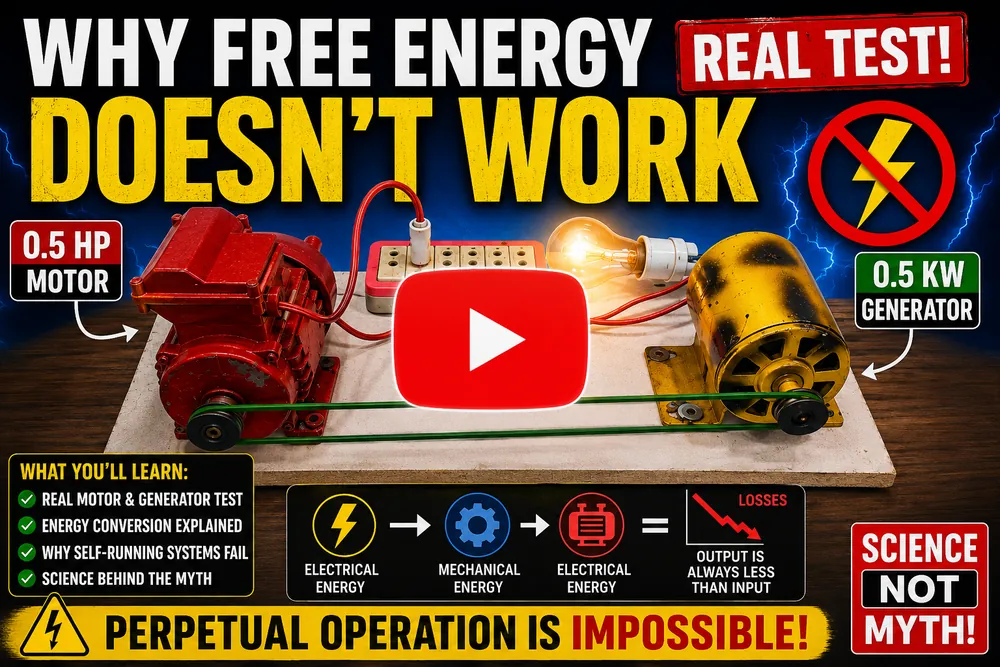
Why Free Energy Generators Don't Work | Real Motor Generator Test & Scientific Explanation
Discussion
No comments yet. Be the first to join the conversation!