

How to Build a DIY Wooden BLDC Motor Using 20 Magnets and 15 Coils: Complete Step-by-Step Guide
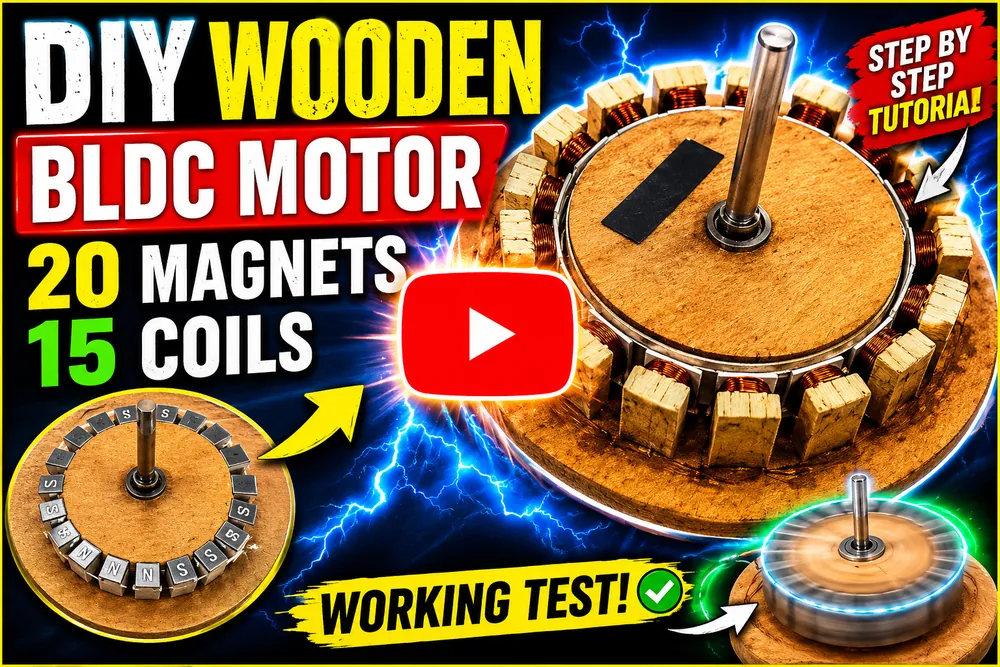
Building a Brushless DC (BLDC) motor from simple materials is one of the most exciting DIY engineering projects for electronics enthusiasts and makers. In this project, a fully functional wooden BLDC motor is constructed using 20 powerful magnets, 15 carefully wound coils, and a custom wooden frame. The build demonstrates that high-performance electric motors do not always require expensive metal housings or industrial manufacturing equipment. By combining precise magnet placement, accurate coil winding, and proper electrical connections, a wooden structure can be transformed into a smooth-running and efficient motor. This project is perfect for hobbyists who want to learn about motor design, electromagnetic principles, and practical engineering skills while creating a working machine from scratch. The entire process covers stator preparation, rotor alignment, coil fabrication, electrical wiring, and final testing.
Preparing the Wooden Stator and Marking Coil Positions
The first stage of the project involves preparing the wooden stator plate and accurately marking the positions where all 15 coils will be installed. Precision during this step is essential because the spacing of the coils directly affects the balance, efficiency, and smooth operation of the finished motor. A circular wooden plate serves as the stator foundation, and the center point must be identified before any measurements begin. Using a ruler, compass, protractor, or printed template, the circular area is divided into fifteen equal sections. Equal spacing ensures that the magnetic field produced by the coils remains balanced during operation. Careful measurement helps eliminate alignment problems that could appear later during assembly. Every mark should be checked multiple times before proceeding to ensure maximum accuracy.
Once the coil locations are marked, the rotor mounting position is prepared at the center of the stator plate. The rotor is then temporarily installed and rotated by hand to verify proper clearance and alignment. Any wobble, imbalance, or friction must be corrected before moving forward. A perfectly centered rotor minimizes vibration and mechanical losses during operation. This careful preparation creates a solid foundation for the entire project and significantly improves the final motor's performance. Proper planning at this stage reduces troubleshooting later and contributes to a more professional and reliable build.
Constructing the Rotor and Installing the 20 Magnets
The rotor is one of the most important components of the BLDC motor because it contains the permanent magnets that interact with the electromagnetic fields generated by the stator coils. In this project, twenty magnets are installed around the rotor with equal spacing. The magnets must be positioned carefully to maintain proper balance and ensure smooth rotation. Each magnet should be securely attached using a strong adhesive capable of resisting centrifugal forces generated during operation.
Correct magnetic polarity is equally important. The magnets are typically arranged in an alternating north-south pattern around the circumference of the rotor. This alternating magnetic arrangement creates the changing magnetic field required for BLDC motor operation. During installation, special care must be taken because strong magnets can suddenly attract each other and cause injury or damage if handled carelessly.
After all magnets have been installed, the rotor should be checked for balance. An unbalanced rotor can cause vibration, increased bearing wear, and reduced efficiency. Slowly rotating the rotor by hand allows any imbalance to be identified and corrected before final assembly. Once properly aligned and balanced, the rotor becomes ready for integration with the stator assembly. This stage represents a critical milestone because the interaction between the rotor magnets and stator coils ultimately determines the motor's performance and efficiency.
Building Coil Bobbins and Winding the 15 Coils
The next phase involves constructing the bobbins that will hold the motor coils. Fifteen identical bobbins are required because the motor uses fifteen separate coils. Small wooden pieces are cut to identical dimensions to ensure uniformity across all coils. Consistency is extremely important because differences in bobbin size can affect winding capacity and coil characteristics.
After cutting the wooden pieces, additional support blocks are attached using wood glue to create the basic bobbin structure. PVC pieces are then mounted onto the wooden frames to provide a smooth central core for winding copper wire. This combination of wood and PVC creates a lightweight, durable, and cost-effective bobbin design that is easy to reproduce using readily available materials.
Once the bobbins are complete, coil winding begins. AWG21 copper wire with a diameter of approximately 0.723 mm is used because it offers a good balance between current-carrying capability and ease of winding. Each bobbin receives exactly forty turns of wire. Maintaining the same number of turns on every coil is essential for balanced electrical performance. During winding, the wire should be placed neatly and tightly without excessive overlap. The winding direction must remain consistent across all fifteen coils to ensure proper phase relationships later. Careful winding produces a professional-looking stator assembly and contributes significantly to smooth motor operation.
Installing the Coils on the Stator Assembly
After winding is complete, the coils are installed onto the stator plate according to the markings created earlier. Glue is applied carefully to each marked location, and the coils are positioned one by one around the rotor. Equal spacing between coils is essential because uneven placement can create irregular magnetic fields and reduce motor efficiency.
Each coil must be aligned correctly and firmly secured before the adhesive sets. The installer should continuously verify that no coil interferes with rotor movement. Proper positioning ensures that the magnetic field generated by each coil contributes effectively to the motor's operation. The arrangement should appear symmetrical and organized, making future wiring easier and improving overall reliability.
After all fifteen coils are installed, the rotor should again be rotated manually to confirm that there is no contact between the rotor and stator components. Any misaligned coil should be adjusted immediately before the glue cures completely. At this stage, the stator begins to resemble a complete motor assembly, and the project moves closer to becoming operational. The careful installation of coils not only improves efficiency but also enhances the overall appearance and professionalism of the build.
Creating the Three-Phase Electrical Connections
The electrical wiring stage transforms the coil assembly into a functional three-phase BLDC motor. The fifteen coils are divided into three separate groups, with each group containing five coils. The connection sequence is extremely important because it establishes the motor's phase arrangement and determines how it interacts with the controller.
The process begins by connecting the ending wire of one coil to the starting wire of another coil according to the specified sequence. In this design, the ending wire of the first coil is connected to the starting wire of the fourth coil, skipping two coils in between. This pattern continues around the stator until all five coils in a group are connected together. The same procedure is repeated for the remaining coil groups, resulting in three independent circuits.
Once the three circuits are complete, six wires remain: three starting leads and three ending leads. The ending leads are joined together to create a common neutral point, forming a three-phase star configuration. The three starting wires become the motor's phase outputs and connect directly to the electronic speed controller (ESC). Proper insulation and secure connections are crucial during this stage because wiring errors can affect motor performance or prevent operation altogether. A clean and organized wiring layout also simplifies maintenance and troubleshooting in the future.
Testing the Wooden BLDC Motor and Evaluating Performance
The final stage is undoubtedly the most exciting part of the project. After all mechanical and electrical work has been completed, the motor is connected to a suitable BLDC controller and prepared for its first test. The phase wires are attached to the controller, and power is supplied through an appropriate battery source. When the controller is activated, the rotor begins rotating smoothly, demonstrating that the winding, magnet placement, and electrical connections have been completed correctly.
Successful operation confirms that the stator coils are generating balanced magnetic fields and interacting properly with the rotor magnets. Smooth acceleration, stable rotation, and minimal vibration indicate a well-executed build. The project demonstrates that a wooden BLDC motor can achieve impressive performance despite being constructed from simple and inexpensive materials.
Beyond its practical functionality, this project serves as an excellent educational tool. Builders gain hands-on experience with electromagnetism, motor design, electrical wiring, and precision fabrication. The completed motor showcases how creativity and engineering principles can combine to produce an effective working machine. Whether used for experimentation, learning, or demonstration purposes, the wooden BLDC motor represents a rewarding achievement for any DIY enthusiast. As always, safety precautions should be followed when handling magnets, power tools, electrical components, and batteries. With patience, accuracy, and attention to detail, this project proves that remarkable engineering results can be achieved using basic materials and a passion for innovation.
Frequently Asked Questions (FAQs) About DIY Wooden BLDC Motor
| No. | Question | Answer |
|---|---|---|
| 1 | What is a BLDC motor? | A BLDC (Brushless DC) motor is an electric motor that operates without brushes and uses electronic commutation for efficient and reliable performance. |
| 2 | How many magnets are used in this wooden BLDC motor project? | This project uses 20 permanent magnets mounted on the rotor in an alternating north-south arrangement. |
| 3 | How many coils are required for the motor? | The motor uses 15 coils arranged evenly around the wooden stator plate. |
| 4 | What wire is used for winding the coils? | AWG21 copper wire with a diameter of approximately 0.723 mm is used for winding the motor coils. |
| 5 | How many turns are wound on each coil? | Each coil is wound with 40 turns of copper wire to ensure balanced electrical performance. |
| 6 | Why is equal coil spacing important? | Equal spacing helps create a balanced magnetic field, reduces vibration, and improves motor efficiency and smooth operation. |
| 7 | What type of connection is used for the motor coils? | The coils are connected in a three-phase star (Y) configuration, which provides stable motor operation and compatibility with BLDC controllers. |
| 8 | Can a wooden BLDC motor produce useful power? | Yes, when built correctly, a wooden BLDC motor can operate efficiently and demonstrate practical motor functionality for educational and experimental purposes. |
| 9 | What controller is needed to run the motor? | A compatible BLDC motor controller or Electronic Speed Controller (ESC) is required to drive the motor and control its speed. |
| 10 | Is this project suitable for beginners? | Yes, but beginners should have basic knowledge of electronics and follow all safety precautions when working with magnets, tools, and electrical components. |
Conclusion
Building a DIY wooden BLDC motor using 20 magnets and 15 coils proves that innovative engineering does not always require expensive materials or complex manufacturing equipment. By carefully designing the stator, accurately positioning the magnets, winding uniform coils, and creating proper three-phase electrical connections, it is possible to construct a fully functional brushless DC motor from simple and readily available materials. Throughout this project, every step—from marking the coil positions and building the bobbins to wiring the phases and testing the completed motor—demonstrates the importance of precision, patience, and attention to detail.
This project is not only an exciting hands-on build but also an excellent learning experience for anyone interested in electronics, electromagnetism, and motor technology. It provides valuable insight into how BLDC motors operate and how magnetic fields interact to create smooth rotational motion. The successful operation of the motor highlights the effectiveness of the design and the potential of DIY engineering projects. Whether you are a hobbyist, student, maker, or electronics enthusiast, this wooden BLDC motor project offers a rewarding opportunity to develop practical skills while creating something truly impressive. With proper safety precautions and careful construction, this project can inspire even more advanced motor and generator builds in the future.
Discussion
No comments yet. Be the first to join the conversation!