
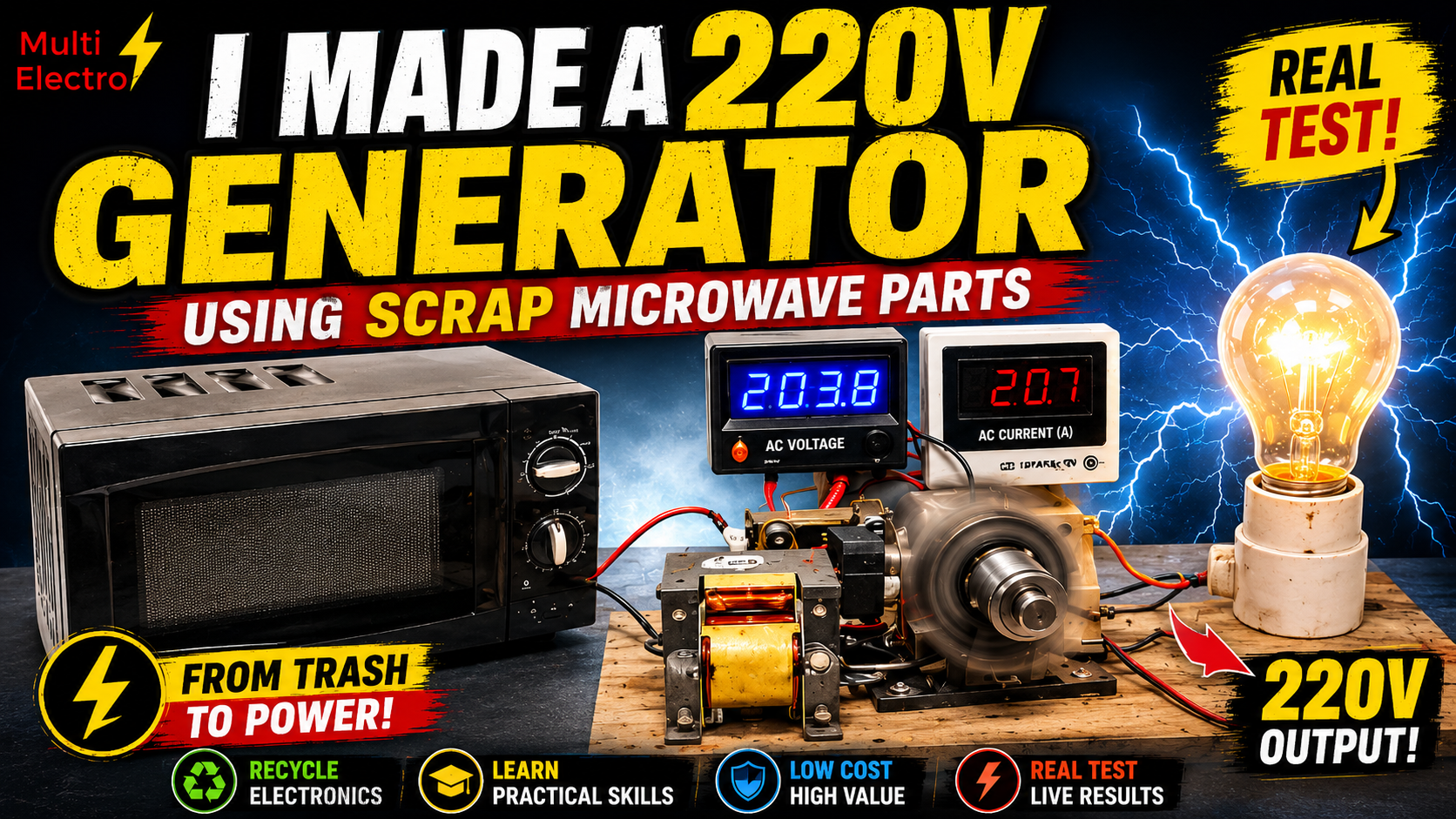
How to Build a DIY 220V Generator Using Recycled Microwave Components
The idea of creating useful electrical devices from discarded electronics has become increasingly popular among DIY enthusiasts, students, and hobbyists. One fascinating project involves reusing components from an old microwave oven to build a simple generator system. The concept demonstrates how valuable parts hidden inside broken appliances can be transformed into educational engineering projects instead of ending up as electronic waste. The source material for this article describes an experiment in which a microwave transformer is modified and combined with a DC motor to produce electrical output while highlighting the importance of safety, creativity, and technical knowledge.
This type of project is attractive because it combines recycling with practical electronics. Rather than purchasing expensive components, builders can learn about transformers, windings, motors, and power generation by reusing materials that might otherwise be discarded. The experiment also helps explain the relationship between mechanical motion and electrical energy, which is the basic principle behind most generators used around the world today.
Although the project is educational, it is important to understand that working with electricity can be dangerous. High voltages can cause serious injury or damage equipment if handled incorrectly. Anyone attempting similar experiments should have a solid understanding of electrical safety, proper insulation techniques, and the correct use of measuring instruments. The original demonstration repeatedly emphasizes the importance of taking precautions when dealing with electrical systems.
In this article, we will explore the complete process, discuss the major components involved, explain how the system works, and examine the lessons that can be learned from transforming old electronics into a functioning generator. Rather than focusing solely on construction details, we will also explore the engineering principles behind the experiment and the value of electronic recycling.
Most importantly, this project serves as a reminder that innovation often begins with curiosity. Many useful inventions and learning experiences come from examining everyday objects and discovering new ways to use them. By understanding the science behind common appliances, anyone interested in electronics can develop valuable practical skills and gain a deeper appreciation for how electrical systems operate.
Understanding the Microwave Transformer and Its Role
At the heart of the project is the microwave oven transformer, commonly known as a MOT. Inside most microwave ovens, this transformer is responsible for converting household electrical power into the high voltage required by the microwave's magnetron. Because of its rugged construction and large iron core, it can be repurposed for a variety of experimental applications when handled correctly. According to the source material, the transformer is carefully removed from the microwave and prepared for modification.
The first step involves cleaning and inspecting the transformer. During examination, it becomes clear that the transformer contains multiple windings. One winding uses thinner wire and is intended for high-voltage output, while another winding uses thicker wire and serves the primary side connected to the mains supply. Understanding the purpose of these windings is essential because transformer performance depends heavily on the number of turns and wire characteristics.
In the experiment, the high-voltage winding is removed and replaced with a new winding made from thicker copper wire. The builder uses a 6 mm copper conductor and carefully wraps fourteen turns around the transformer core. Each turn must be neatly arranged and tightly secured to ensure efficient operation and stable performance. The number of turns directly influences the output voltage and current capability of the transformer.
This modification effectively transforms the microwave transformer into a different type of electrical device suited to the goals of the experiment. By redesigning the secondary winding, the builder creates a low-voltage, high-current output that can later interact with other parts of the generator system. The exercise provides an excellent demonstration of how transformer ratios determine electrical behavior.
Beyond the practical construction process, this stage teaches an important lesson about electromagnetic induction. Transformers operate by transferring energy through magnetic fields rather than direct electrical connections. Whenever current flows through one winding, a magnetic field is created in the iron core, which induces voltage in the other winding. Understanding this principle provides a strong foundation for studying motors, generators, and power systems.
Testing and Verifying the Modified Transformer
Once the transformer has been rewound, testing becomes essential. Before applying full power, the experiment introduces a simple but effective safety measure by connecting a 200-watt light bulb in series with the transformer. This bulb acts as a current limiter, helping protect both the transformer and the operator during initial testing. It also provides a visual indication of system behavior.
When the system is energized, the brightness of the bulb reveals important information. A dim glow generally indicates that there are no significant short circuits and that the transformer is behaving normally. When the output is briefly connected in a manner described in the demonstration, the bulb becomes brighter, showing increased current flow. This confirms that the modified transformer is functioning as intended and is capable of handling electrical energy correctly.
The next stage involves measuring the output voltage using a multimeter. Accurate measurements are critical in any electrical project because assumptions can lead to component damage or unsafe operating conditions. The demonstration reports an output of approximately 8.4 volts after the transformer modification. This result confirms that the new winding ratio is producing the expected low-voltage output.
Testing also reinforces the importance of methodical engineering practices. Experienced technicians rarely move directly from construction to final operation without verifying intermediate results. By checking voltage levels, observing component behavior, and identifying potential faults early, builders can avoid expensive mistakes and improve overall reliability.
Another valuable lesson from this stage is the role of observation in troubleshooting. Electrical engineering often involves interpreting signs such as voltage readings, current measurements, temperature changes, and visual indicators. The simple bulb test used in this experiment demonstrates how even basic tools can provide meaningful information about the health of a circuit.
Ultimately, successful testing confirms that the modified transformer is ready for integration into the generator system. It also provides confidence that the earlier winding modifications were completed correctly and that the project can safely proceed to the next phase.
Modifying the DC Motor and Commutator System
After preparing the transformer, attention shifts to the DC motor and commutator assembly. The commutator is a critical component because it manages electrical connections while rotating. In the experiment, the commutator contains twelve contact points, and every alternate contact is connected together. This modification helps prepare the system for controlled electrical transfer during operation.
The modified commutator is then installed onto the motor shaft in place of the original pulley. Proper alignment is essential because even slight mechanical inaccuracies can lead to vibration, poor electrical contact, and reduced efficiency. The demonstration emphasizes securing all connections carefully to ensure smooth rotation and reliable performance.
Additional wiring is attached to the commutator and motor body to establish the required electrical pathways. These connections allow current to be transferred effectively while the shaft rotates. The motor itself is mounted securely to a wooden base, which provides mechanical stability and a degree of electrical insulation. Proper mounting reduces vibration and helps maintain consistent operation.
A battery-powered system is used to drive the motor. Although a higher-voltage battery is available, a voltage controller reduces the supply to approximately 12 volts, ensuring that the motor operates within a safe range. This demonstrates another important engineering principle: components should always be operated within their designed specifications whenever possible.
From an educational perspective, this stage highlights the connection between electrical and mechanical systems. Motors convert electrical energy into motion, while generators perform the reverse process. Because the underlying principles are closely related, many machines can function as either motors or generators under the right conditions. Understanding this relationship helps explain how energy conversion devices operate across countless industrial applications.
The commutator modification also provides insight into how rotating electrical machinery manages current flow. Whether found in power tools, automotive systems, or industrial equipment, commutators play a crucial role in directing electrical energy while allowing continuous rotation. Learning about these components helps build a stronger understanding of electromechanical engineering.
Generating Electricity Through Mechanical Motion
With both the transformer and motor prepared, the experiment enters its most exciting stage: generating electricity. The motor is powered and allowed to reach a stable operating speed. Once rotation is established, connections are made between the transformer output and the commutator arrangement. This setup creates the conditions necessary for electrical generation through mechanical movement.
As the motor rotates, electrical interactions occur within the modified system. The experiment demonstrates that measurable electrical output is produced, confirming that mechanical energy is being converted into electrical energy. Instruments are connected to monitor both the motor input and generator output, allowing the operator to verify system performance in real time.
The use of measurement equipment is particularly important because it transforms a simple demonstration into a scientific experiment. Rather than relying on assumptions, the builder collects data directly from the system. This approach encourages analytical thinking and helps identify opportunities for future improvements.
One of the most valuable educational outcomes of the project is understanding the concept of energy conversion. Every generator, regardless of size, operates by converting one form of energy into another. Large power stations use steam turbines, hydroelectric dams use flowing water, and wind turbines use moving air. In this experiment, a motor-driven mechanical system performs the same basic function on a much smaller scale.
The project also demonstrates that useful engineering concepts can be explored without access to expensive laboratory equipment. By combining recycled components, basic tools, and careful observation, builders can gain hands-on experience with fundamental electrical principles. This practical learning approach often provides deeper understanding than theory alone.
Most importantly, the successful generation of electricity validates the effort invested in modifying and assembling the system. Seeing electrical output appear from a collection of recycled parts reinforces the power of creativity, experimentation, and technical problem-solving.
Lessons, Safety Considerations, and the Value of Recycling Electronics
Beyond the technical aspects, this project carries several broader lessons. First, it highlights the importance of recycling electronic waste. Many discarded appliances contain transformers, motors, switches, wires, and other components that remain functional long after the original device stops working. Reusing these materials can reduce waste while providing valuable educational opportunities.
Second, the experiment demonstrates how engineering knowledge can unlock hidden value in everyday objects. What appears to be a broken microwave oven may actually contain components suitable for countless learning projects. By understanding how electronic devices operate, individuals can extend the life of useful materials and develop practical technical skills.
Safety, however, must always remain the highest priority. The source repeatedly warns that working with electricity—particularly mains voltage and transformer systems—can be hazardous. Proper insulation, protective equipment, safe work practices, and technical understanding are essential. Experiments involving high voltage should never be attempted casually or without appropriate knowledge and supervision.
For students and hobbyists, projects like this provide an excellent introduction to concepts such as transformers, electromagnetic induction, electrical measurements, energy conversion, and system testing. These are the same principles used in professional electrical engineering environments, making small-scale experiments valuable stepping stones toward more advanced learning.
In conclusion, the DIY generator project serves as a powerful example of innovation through recycling. By repurposing a microwave transformer and combining it with a modified motor system, the experiment demonstrates how mechanical motion can be transformed into electrical power. More importantly, it encourages curiosity, creativity, and hands-on learning while reminding us that safety and responsible engineering practices should always come first. The project proves that even discarded electronics can become valuable educational tools when approached with knowledge, patience, and imagination.
Conclusion
Building a DIY 220V generator from recycled microwave components is an inspiring example of how creativity, technical knowledge, and resourcefulness can transform discarded electronics into a valuable educational project. Throughout this experiment, we explored the process of modifying a microwave transformer, rewinding its coils, testing its performance, and integrating it with a modified DC motor system to demonstrate the principles of electrical power generation.
More than just a generator project, this experiment highlights the importance of understanding how electrical components work and how they can be repurposed for new applications. It demonstrates the fascinating relationship between mechanical motion and electrical energy while encouraging hands-on learning and practical problem-solving skills. By reusing old electronic parts, we also contribute to reducing electronic waste and promoting sustainable engineering practices.
However, safety must always remain the top priority. Working with transformers, motors, and high-voltage electricity requires proper knowledge, protective measures, and careful attention to detail. Anyone interested in similar projects should fully understand the risks involved and follow appropriate safety procedures at every stage.
Ultimately, this project serves as a powerful reminder that innovation often begins with curiosity. With the right combination of learning, experimentation, and responsible engineering practices, ordinary discarded appliances can become valuable tools for education, exploration, and technological creativity. Whether you are a student, hobbyist, or electronics enthusiast, projects like this offer an exciting opportunity to deepen your understanding of electrical engineering while discovering the hidden potential inside everyday devices.

Discussion
No comments yet. Be the first to join the conversation!