

Transforming a 72V Hub Motor into a 220V Three-Phase Generator
Introduction to the Hub Motor Generator Conversion
Electric hub motors are commonly used in e-bikes and electric scooters because of their compact size, efficiency, and reliability. Most people see these motors only as transportation components, but with proper engineering knowledge, they can be transformed into powerful electricity generators. In this project, a standard 72V electric hub motor was completely rewound and redesigned to generate 220V three-phase AC power. This fascinating conversion demonstrates how brushless motors and generators operate on very similar principles.
The project begins with opening the sealed hub motor and inspecting the internal components. Inside the motor are permanent magnets, copper windings, phase wires, bearings, and a stator assembly. Understanding the original configuration is extremely important because the new generator design depends on the original slot arrangement and magnetic structure. Careful documentation of the winding direction, slot count, and wire thickness allows accurate redesign calculations later in the process.
A key feature of this hub motor is its 54-slot stator design. This slot arrangement plays a major role in determining the final winding pattern and phase balance of the generator. Engineers and hobbyists often prefer motors with higher slot counts because they provide smoother power generation and better magnetic distribution. By studying the original winding carefully, the builder can calculate the correct number of turns needed for higher voltage output.
The original factory winding was designed for low-voltage, high-current operation. Hub motors in electric vehicles typically use thick copper wire with very few turns to maximize torque. However, a generator requires a different approach. To increase voltage output, the rewinding process increases the number of turns while reducing the number of parallel wires. This modification allows the motor to generate higher voltage at moderate rotational speeds.
This project is much more than a simple DIY experiment. It combines electrical engineering, motor design, magnetic theory, and practical machining techniques into a complete learning experience. By the end of the build, the rewound motor successfully produces approximately 220V three-phase electricity, proving that careful calculations and precise winding techniques can completely transform an old electric hub motor into a working power generator.
Understanding the Winding Calculations
One of the most critical parts of the project is calculating the correct number of winding turns for the desired voltage output. Without accurate calculations, the generator would either produce insufficient voltage or become inefficient and unstable. The builder first examined the original winding configuration and discovered that each coil contained only three turns of copper wire. Since the stator used 18 coils per phase, the original setup contained a total of 54 turns per phase winding.
The original hub motor was designed for 72V operation. By dividing the total turns by the original voltage, the builder calculated that each turn produced approximately 0.75 volts. This voltage-per-turn calculation became the foundation for designing the new high-voltage generator winding. Once the voltage-per-turn value was known, determining the required turns for 220V became straightforward.
To achieve approximately 220V output, the project required around 165 turns per phase. Dividing this total by the 18 coils resulted in approximately nine turns per coil. The builder selected nine turns as the practical winding value because it closely matched the target voltage while still fitting within the available slot space. Accurate turn calculations are essential because even small differences can significantly affect generator output voltage and efficiency.
The project also required modifications to the wire configuration. The original factory winding used 21 parallel copper wires to handle high current loads. Since the generator design focused on increasing voltage rather than current, the rewinding setup used only seven parallel wires while maintaining the same wire gauge. This approach created enough room inside the stator slots for the additional turns needed for higher voltage generation.
Proper winding calculations are the backbone of any generator conversion project. Every aspect of performance, including voltage stability, current capability, efficiency, and heat management, depends on accurate mathematical planning. Without proper calculations, the final generator would not operate correctly or safely. This stage of the project highlights the importance of combining theoretical electrical knowledge with practical engineering skills.
Rewinding the 54-Slot Stator
After completing the calculations, the rewinding process began. The builder used 0.541 mm enamel-coated copper wire arranged in seven parallel strands. This configuration balanced the need for increased voltage with the limited physical space available in the stator slots. Rewinding a stator requires patience and precision because each coil must be positioned correctly to maintain proper phase balance and magnetic polarity.
The project used a two-pitch winding design, meaning each coil spanned two slot pitches across the stator. Pitch selection is extremely important because it affects voltage generation, waveform quality, and generator efficiency. Incorrect pitch design can result in poor phase synchronization, unstable output, and excessive vibration during operation.
The winding direction followed a right-left-right pattern throughout the stator. Maintaining consistent winding direction ensures proper magnetic polarity and balanced three-phase operation. Each coil group contained three coils connected together, and each phase consisted of six complete groups evenly distributed around the stator. Careful slot counting and continuous inspection helped prevent winding errors during the process.
Another important aspect of the design was the spacing between coil groups. After completing one three-coil group, the builder intentionally left five empty slots before beginning the next group. This spacing was not random; it was based on the electrical relationship between the stator slots and rotor magnets. Proper slot spacing improves waveform quality, reduces vibration, and enhances phase balance during operation.
As the rewinding progressed, the stator gradually transformed into a completely custom high-voltage generator assembly. The finished winding displayed a symmetrical three-phase structure with carefully organized coil groups and balanced phase placement. This stage required intense concentration because even a single incorrect slot position could disrupt the entire phase arrangement and reduce generator performance.
Phase Connections and Final Assembly
Once the rewinding process was complete, the next stage involved connecting the three phases correctly. Each phase winding had one starting wire and one ending wire. The three starting wires became the main AC output terminals of the generator, while the three ending wires were connected together to create a neutral point. This arrangement is known as a star or Y connection.
Star connections are commonly used in generators because they provide higher output voltage and improved phase balance. They also create smoother AC waveforms and better voltage distribution between phases. Proper phase connection is essential because incorrect wiring can lead to unstable output, overheating, or complete generator failure.
After confirming the wiring sequence, the builder soldered all connections carefully to minimize resistance and ensure reliable electrical contact. High-quality solder joints are especially important in high-voltage projects because loose connections can create heat buildup, voltage drops, and electrical instability. Every connection was inspected to ensure proper bonding and insulation.
The soldered joints were then covered with PVC fiberglass sleeving for insulation and protection. This material is commonly used in electric motors because it provides excellent heat resistance and electrical insulation. The wires were carefully arranged and secured inside the stator to prevent movement during high-speed rotation. Proper cable management helps protect the generator from vibration-related damage and short circuits.
Finally, the stator was reinstalled into the motor housing and aligned with the permanent magnet rotor. Since the magnets produce strong attraction forces, assembly required careful alignment to avoid damaging the windings. After reinstalling the side covers and checking bearing movement, the custom-built generator was fully assembled and ready for performance testing.
Testing and Final Performance Results
The completed generator was mounted onto a custom-built testing frame to ensure safe operation during high-speed rotation. A stable mounting platform is essential because generators produce significant vibration and mechanical forces during operation. The testing setup also allowed easy access for voltage measurement and performance monitoring.
Initial testing involved rotating the generator slowly by hand. Even at low speed, the multimeter displayed approximately 17 volts, confirming that the rewound motor was generating electricity successfully. However, some vibration was observed during testing, likely caused by imbalance in the rotor assembly after rewinding.
To reduce vibration, the builder mounted the motor on a lathe machine and carefully removed small amounts of material from the outer edges of the hub motor. Balancing is extremely important in generator design because smooth rotation improves efficiency, reduces noise, and protects bearings and internal components from wear. After balancing, the generator operated much more smoothly at higher RPM.
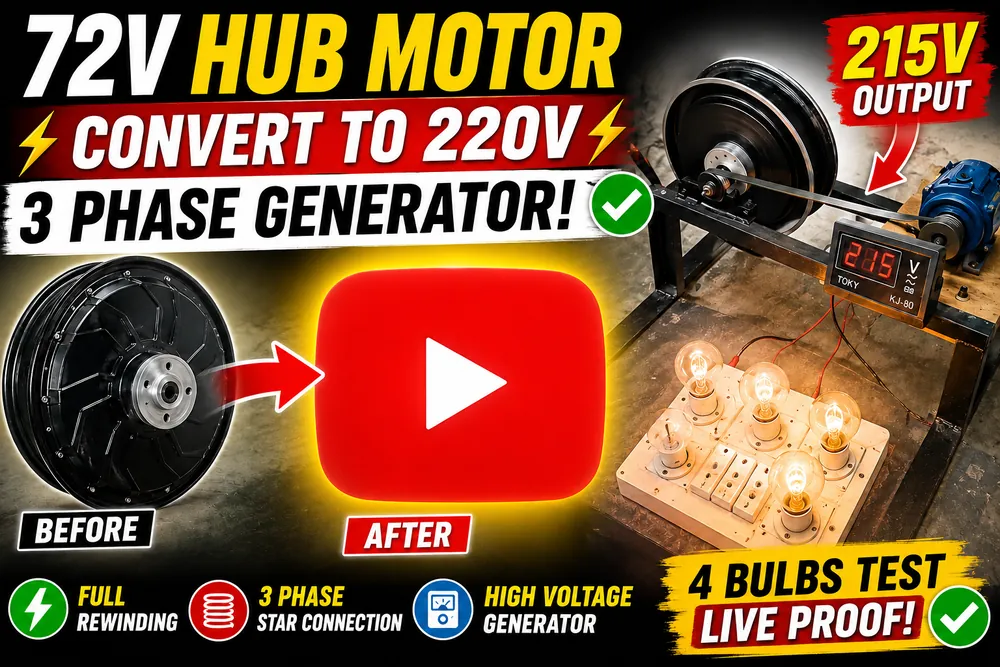
For the final test, the hub motor generator was connected to an external electric motor that provided stable rotational speed. As the RPM increased, the output voltage also increased. Eventually, the multimeter displayed approximately 215 volts, confirming that the rewinding calculations and phase connections were successful. The generator produced stable three-phase output with significantly reduced vibration.
The project concluded with a practical load test using four light bulbs powered directly by the generator. All bulbs illuminated successfully, proving that the converted hub motor could produce usable electrical power. This impressive result demonstrated how careful engineering, accurate calculations, and proper rewinding techniques can transform a standard 72V electric hub motor into a fully functional 220V three-phase generator.
Conclusion
Transforming a 72V electric hub motor into a 220V three-phase generator is an impressive example of practical electrical engineering and creative innovation. This project demonstrated how a standard low-voltage brushless motor can be completely redesigned through careful calculations, precise rewinding techniques, and accurate phase configuration. From dismantling the original hub motor to calculating the correct number of winding turns and rebuilding the stator from scratch, every stage required patience, technical knowledge, and attention to detail.
The successful generation of approximately 215V during final testing proved that the rewinding calculations and winding layout were accurate. By increasing the number of turns per coil and redesigning the phase connections using a star configuration, the builder achieved stable three-phase AC output from a motor originally designed for low-voltage electric vehicle use. The project also highlighted the importance of balancing, insulation, and proper assembly in achieving reliable and smooth generator performance.
Beyond the technical achievement, this conversion project serves as an educational demonstration of how electric motors and generators operate on the same electromagnetic principles. It provides valuable insight into stator design, winding patterns, magnetic field distribution, and voltage generation. For engineering enthusiasts, students, and renewable energy hobbyists, this type of hands-on experiment is an excellent way to understand real-world electrical systems in greater depth.
The final load test, where the rewound generator successfully powered multiple light bulbs, confirmed that the converted hub motor could produce usable electrical energy. This achievement showcases the potential of recycling and repurposing old electric vehicle components into functional energy generation systems. Such projects encourage innovation in renewable energy and demonstrate how existing technology can be modified for entirely new applications.
In conclusion, this hub motor generator conversion is not only a remarkable engineering project but also a powerful learning experience. It combines theory, practical skills, and experimentation into a complete demonstration of electrical machine design. With proper safety precautions, technical understanding, and careful workmanship, old electric motors can be transformed into efficient and functional power generators capable of producing real high-voltage electricity.
Frequently Asked Questions (FAQs)
| No. | Question | Answer |
|---|---|---|
| 1 | What is a hub motor generator conversion? | A hub motor generator conversion is the process of transforming an electric hub motor into a power generator capable of producing electricity through rotational motion. |
| 2 | Why was a 72V hub motor used in this project? | A 72V hub motor already contains permanent magnets and a strong stator design, making it suitable for rewinding and high-voltage power generation experiments. |
| 3 | How does rewinding increase the voltage output? | Increasing the number of turns in the stator coils increases the voltage generated per rotation, allowing the motor to produce higher AC voltage. |
| 4 | What type of output does the converted generator produce? | The rewound hub motor produces 220V three-phase AC electricity using a custom star (Y) phase connection. |
| 5 | Why were fewer parallel wires used during rewinding? | Fewer parallel wires created more space inside the stator slots for additional turns required for higher voltage generation. |
| 6 | What is the purpose of the star connection? | A star connection helps achieve higher voltage output, stable phase balance, and smoother three-phase AC generation. |
| 7 | Why is rotor balancing important in this project? | Rotor balancing reduces vibration, improves efficiency, minimizes noise, and protects bearings during high-speed operation. |
| 8 | Can this generator power household appliances? | The generator can power certain electrical loads, but stable operation depends on RPM control, proper regulation, and load capacity. |
| 9 | Is this project safe for beginners? | This project involves high voltage electricity and rotating machinery, so it should only be attempted by individuals with proper technical knowledge and safety equipment. |
| 10 | What can people learn from this generator project? | This project teaches important concepts such as motor rewinding, three-phase power generation, electromagnetic principles, winding calculations, and practical electrical engineering skills. |
Discussion
No comments yet. Be the first to join the conversation!