
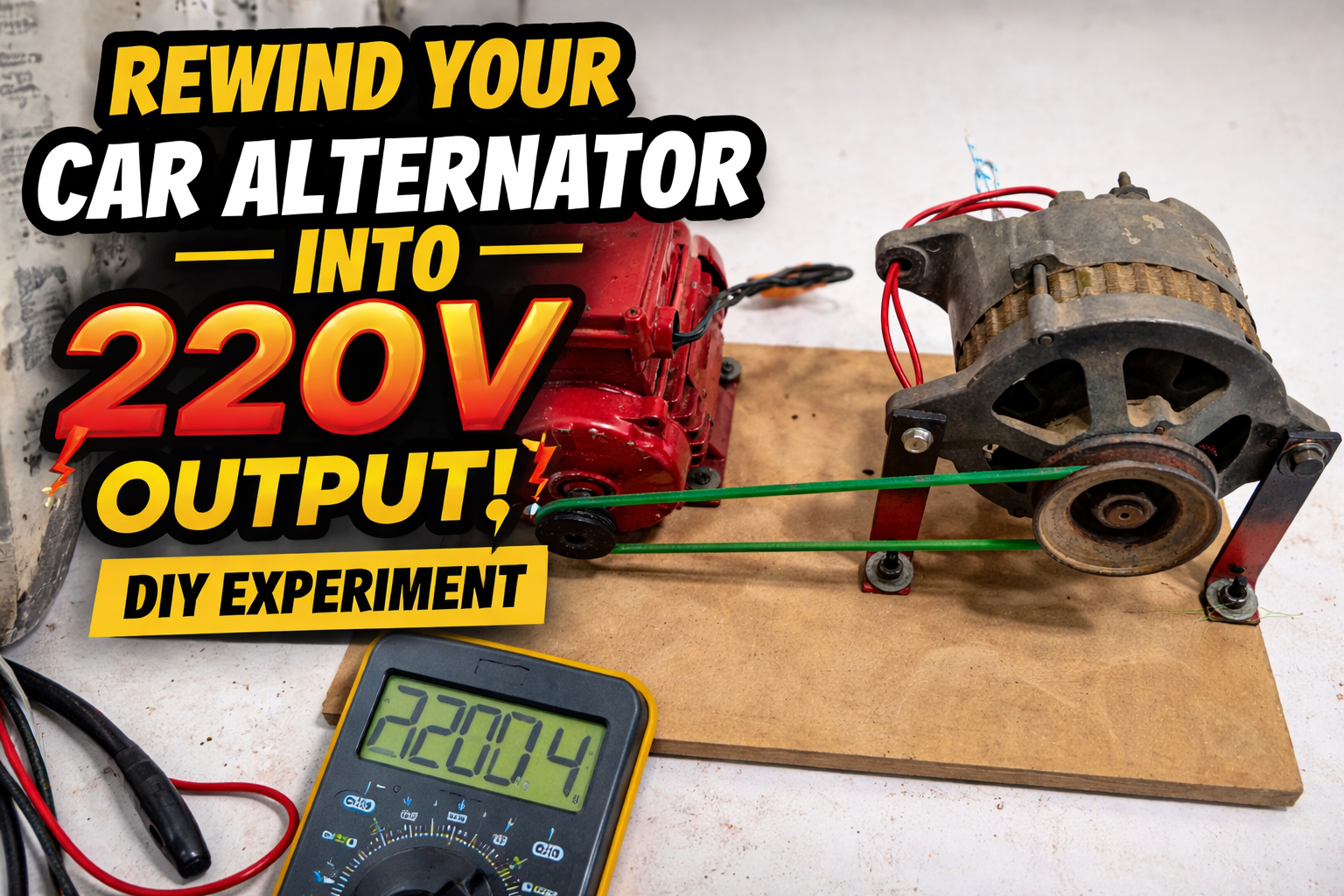
How to Rewind a Car Alternator for 220V Output
Introduction: Can a Car Alternator Really Produce 220 Volts?
If someone told you that the compact alternator sitting beneath your car’s hood could be transformed into a device capable of producing 220 volts of electricity Rewind a Car Alternator, your first reaction might be disbelief. After all, alternators are engineered to support automotive electrical systems — not to power homes, workshops, or heavy appliances. Yet among DIY enthusiasts and technically curious builders, the idea of modifying a car alternator into a high-voltage generator has become an increasingly fascinating experiment. It sits at the intersection of creativity, engineering, and self-reliance, challenging the assumption that specialized equipment must always be purchased rather than built.
To understand why this experiment captures so much attention, it helps to start with the basics. A car alternator is essentially a generator designed to convert mechanical energy into electrical energy. When your engine runs, a belt connected to the crankshaft spins the alternator pulley. Inside, a rotating magnetic field — produced by a component called the rotor — moves within stationary copper windings known as the stator. This motion creates alternating current through electromagnetic induction, one of the foundational principles of electrical engineering.
However, vehicles do not use alternating current directly Rewind a Car Alternator. Most automotive systems operate on about 12 to 14 volts of direct current. To make this possible, alternators include rectifiers that convert the generated AC into DC before sending it to recharge the battery and power the vehicle’s electronics, from headlights and dashboard displays to climate control systems. The entire process happens seamlessly every time you drive, rarely attracting attention unless something fails.
So how does a device built for low-voltage output spark conversations about producing 220 volts — the level typically used in residential power systems in many parts of the world?
The answer lies in the structure of the stator windings. Voltage output in a generator is heavily influenced by the number of turns of copper wire wrapped around its core. More turns can increase voltage, while fewer turns typically allow for higher current. By removing the factory-installed windings and replacing them with a new configuration, it becomes theoretically possible to alter the electrical characteristics of the alternator dramatically. This process, commonly referred to as rewinding, is not new; electric motor technicians have used similar techniques for decades to repair or customize machinery. What makes it exciting in a DIY context is the possibility of repurposing a widely available automotive component into something far more versatile.
This spirit of modification aligns perfectly with the growing popularity of DIY energy projects. Over the past several years, more people have begun questioning their dependence on centralized power grids. Rising electricity costs, severe weather events, and occasional outages have encouraged homeowners to think about backup solutions. Meanwhile, the off-grid movement has shifted from a niche lifestyle into a mainstream aspiration for many who value independence and resilience.
Beyond practicality, there is also a powerful educational appeal. Building or modifying your own power source transforms electricity from an abstract utility into something tangible — something you can measure, test, and truly understand. For hobbyists, the process is as rewarding as the outcome. For students and aspiring engineers, it provides real-world insight that no diagram can fully replicate. And for lifelong tinkerers, it offers the simple but satisfying thrill of asking, “What happens if I try this?”
Still, an important question must be addressed early: is rewinding an alternator to produce 220 volts actually practical, or is it merely an experimental exercise?
The honest answer falls somewhere in between. While it is technically possible to increase an alternator’s voltage output, doing so introduces tradeoffs. Higher voltage often means reduced current capacity, greater heat generation, and increased mechanical stress. Stock alternators were never designed for sustained high-voltage operation, so efficiency may suffer, and long-term durability can become a concern. In other words, this project is unlikely to replace a commercial generator if your goal is to power an entire household reliably.
Yet measuring practicality purely in terms of replacement value misses the bigger picture. Projects like this are fundamentally about learning, experimentation, and expanding your technical abilities. They teach you how electromagnetic systems behave outside of ideal textbook conditions. They reveal the delicate balance between voltage, current, resistance, and temperature. Most importantly, they cultivate the kind of problem-solving mindset that defines skilled builders and engineers.
Before going any further, a serious safety disclaimer is essential. This experiment involves working with high voltage, exposed wiring, and rapidly rotating components — all of which present genuine hazards if handled carelessly. Electric shock can cause severe injury. Poor insulation can lead to dangerous short circuits. Overheated windings may melt protective coatings and create fire risks. Even the mechanical aspect of spinning an alternator at high speeds demands caution, as loose clothing, jewelry, or unsecured parts can quickly become dangerous.
Approach this project with respect for the risks involved. Always use insulated tools, wear protective gloves and eye protection, and test electrical output carefully with appropriate equipment. Never assume a conductor is safe to touch, and never operate modified machinery unattended. Patience and preparation are not optional here — they are critical safeguards.
So who is this guide written for? It is designed for curious minds who enjoy understanding how things work beneath the surface. Hobbyists searching for a meaningful technical challenge will find plenty to explore. Tinkerers who dislike discarding repairable hardware may appreciate the opportunity to give an alternator a second life. Engineering students can benefit from the hands-on perspective that classrooms sometimes lack, while DIY energy enthusiasts may see this as a stepping stone toward larger off-grid ambitions.
You do not need to be a professional electrician to follow along, but a basic comfort with tools and mechanical systems will help enormously. Attention to detail, a willingness to learn, and a cautious mindset matter far more than advanced credentials.
By the time you finish this guide, you can realistically expect to understand how a car alternator functions at a deeper level, what happens when you modify its windings, and whether the resulting output is suitable for any real-world applications. You will also gain insight into the limitations of improvised generators and develop a stronger intuition for electrical design — knowledge that extends far beyond this single experiment.
Will rewinding an alternator magically transform it into a perfect household power source? Probably not. But will the process expand your skills, sharpen your technical judgment, and change the way you think about electricity? Very likely. Because in projects like this, the most valuable output is often not just the voltage you produce — it is the understanding you generate along the way.
Before tearing apart an alternator, let’s understand how it actually works.
Understanding How a Car Alternator Works
Before attempting to modify an alternator to produce higher voltage, it is essential to understand what is happening inside this surprisingly sophisticated piece of machinery. At a glance, a car alternator may look like a simple metal cylinder bolted onto an engine, but internally it is a carefully engineered generator designed for reliability, efficiency, and continuous operation under demanding conditions. By learning how its components work together, you not only reduce the risk of damaging the unit during a rebuild but also gain the technical insight needed to make smarter design decisions when rewinding.
At the heart of every alternator are five core components: the rotor, stator, voltage regulator, rectifier, and the slip rings with brushes. Each plays a specific role in converting mechanical motion into usable electrical power.
The rotor is the rotating electromagnetic core of the alternator. When current flows into the rotor windings, it creates a magnetic field. As the engine spins the alternator pulley, the rotor turns at high speed inside the stator, effectively becoming a rotating magnet. Unlike permanent magnets found in some smaller generators, the rotor’s magnetic strength can be controlled by adjusting the current supplied to it. This controllability is one of the reasons automotive alternators are so stable across varying engine speeds.
Surrounding the rotor is the stator, a stationary ring made up of laminated iron and tightly wound copper coils. While the rotor spins, its magnetic field sweeps past these coils, and this movement is what generates electricity. The stator is where the useful electrical output is born, making it the primary focus of any rewinding project. Changing the number of wire turns, wire thickness, or winding pattern directly alters how the alternator behaves electrically.
Keeping the output stable is the job of the voltage regulator. Cars demand consistent electrical pressure regardless of whether the engine is idling at a stoplight or racing down a highway. The regulator monitors system voltage and adjusts the current feeding the rotor accordingly. If voltage begins to climb too high, it reduces the rotor’s magnetic strength; if voltage drops, it increases it. This constant balancing act protects the battery and sensitive electronics from damage.
Next comes the rectifier, a component many beginners overlook but one that is absolutely critical. Remember that the electricity generated inside the stator is alternating current. Automotive systems, however, rely on direct current. The rectifier uses diodes — electronic one-way valves — to convert AC into DC before it leaves the alternator. Without this conversion, your vehicle’s electrical components would not function properly.
Finally, slip rings and brushes provide the pathway that allows electricity to flow into the spinning rotor. The brushes remain stationary while maintaining contact with the rotating slip rings, ensuring uninterrupted current delivery. Though small, these parts experience constant friction and are often among the first components to wear out over time.
Understanding these pieces individually is helpful, but the real magic lies in how they work together to transform motion into power. When the engine rotates the alternator belt, mechanical energy is transferred into rotational motion. The energized rotor produces a magnetic field that moves rapidly past the stator windings. This changing magnetic environment forces electrons within the copper wires to move, generating an electrical current. This phenomenon is known as electromagnetic induction, and it forms the backbone of nearly all modern power generation — from massive hydroelectric dams to compact portable generators.
For readers new to electrical concepts, think of electromagnetic induction as a relationship between motion and magnetism. Whenever a magnetic field changes around a conductor, voltage is created. Faster changes typically mean higher voltage, which is why rotational speed plays such an important role in generator performance.
Although alternators generate AC internally, what reaches your car battery is carefully regulated DC power. Most vehicles operate within a narrow range of roughly 13.5 to 14.5 volts while running. Amperage varies depending on the alternator’s design, but modern units commonly produce anywhere from 60 to over 150 amps. This combination of relatively low voltage and high current is ideal for charging batteries quickly and supporting multiple electrical loads simultaneously.
To truly grasp how rewinding affects output, it helps to simplify a few electrical fundamentals. Magnetic fields act as the driving force behind induction. The stronger the magnetic field passing across the stator coils, the greater the potential voltage generated. Coil windings determine how effectively that magnetic energy is captured. Adding more turns increases voltage because each loop of wire experiences the changing magnetic field, effectively stacking electrical potential.
However, electrical systems are governed by tradeoffs. When you increase the number of turns using thinner wire to fit within the same space, resistance rises. Higher resistance limits the amount of current the wire can safely carry without overheating. This is why boosting voltage often reduces available amperage — a crucial consideration if you hope to power real devices rather than simply achieve an impressive meter reading.
Rotational speed adds another layer to this relationship. Voltage output scales with RPM, meaning the faster the rotor spins, the greater the electrical pressure produced. Automotive alternators are typically geared to perform efficiently across common engine speeds, but when modified for higher voltage, they may require different operating speeds to reach desired output levels. Push them too fast, and mechanical wear accelerates; run them too slowly, and voltage may never reach useful levels.
This balancing act explains why stock alternators have inherent limitations. They were engineered with a specific purpose: delivering stable, low-voltage DC power for automotive use over tens of thousands of miles. Their cooling systems, internal spacing, insulation materials, and bearing tolerances all reflect that mission. When you attempt to force significantly higher voltage from the same hardware, you begin operating outside those design boundaries.
Heat becomes one of the biggest challenges. Electrical resistance converts some energy into thermal buildup, and excessive temperatures can degrade insulation or warp internal components. Efficiency can also drop, meaning more mechanical input is required for the same electrical output. Additionally, the rectifier and regulator may not tolerate voltages far beyond their intended range, often requiring modification or replacement during advanced builds.
None of this means the experiment is doomed — only that understanding the constraints allows you to work smarter. Successful builders recognize that an alternator is not a blank canvas but a platform with physical and electrical boundaries. Respecting those boundaries is the difference between a rewarding experiment and a frustrating failure.
By now, you should see the alternator not as a mysterious automotive part but as a compact, controllable generator governed by clear scientific principles. Every rotation, every magnetic pulse, and every loop of copper wire contributes to the final electrical output. Once you understand these relationships, the idea of rewinding stops feeling like guesswork and starts resembling deliberate engineering.
Now that we know what we’re modifying, let’s prepare for the rebuild.
Tools, Materials, and Preparation for Rewind a Car Alternator
A successful alternator rewinding project begins long before the first bolt is loosened. Preparation is what separates a smooth, educational build from a frustrating and potentially dangerous experience. While the concept of modifying an alternator to produce higher voltage may sound adventurous, the reality is that careful planning, the right equipment, and a disciplined workspace will dramatically improve both safety and results. Think of this stage as laying the foundation — if it is solid, everything that follows becomes far more manageable.
The first step is assembling a complete set of tools and materials. Trying to improvise midway through the process often leads to mistakes, damaged components, or unsafe wiring. One of the most essential tools you will need is a reliable multimeter. This device allows you to measure voltage, resistance, and continuity, making it indispensable for diagnosing the alternator before disassembly, verifying your new windings, and safely testing output later. Investing in a quality multimeter is worthwhile; inaccurate readings can mislead your entire build.
A bearing puller is another critical tool that many beginners underestimate. Alternators are tightly assembled, and bearings are often pressed firmly onto the shaft. Attempting to remove them without the proper tool can bend the rotor shaft or crack the housing, instantly turning a promising project into scrap metal. A controlled, even pulling force protects the internal geometry and ensures the unit can be reassembled correctly.
You will also need solid soldering tools — ideally a temperature-controlled soldering iron with quality solder designed for electrical work. Strong electrical connections are non-negotiable when dealing with higher voltages. Cold solder joints or poorly bonded wires introduce resistance, generate heat, and may eventually fail under load. Taking the time to produce clean, durable connections is one of the hallmarks of skilled electrical work.
Of course, rewinding would be impossible without insulated copper wire. Selecting the proper wire is more important than many first-time builders realize. The enamel coating acts as insulation between tightly packed turns, preventing short circuits within the winding itself. When aiming for higher voltage, builders typically use thinner wire to fit more turns into the stator slots. However, thinner wire increases resistance and reduces current capacity, so balance is key. Avoid cheap or poorly coated wire — it can nick easily during installation and create hidden faults that are difficult to trace later.
Protective gloves and safety goggles should never be considered optional. During disassembly, sharp metal edges are common, and small fragments can break free when removing old windings. Later, when testing the alternator, eye protection becomes even more important. Electrical work rewards caution, and simple protective gear dramatically reduces risk.
Choosing the right alternator may be the most overlooked decision in the entire project. Older alternator models are often easier to modify because they tend to have simpler internal layouts and fewer integrated electronics. Many modern units combine regulators and rectifiers into compact assemblies that are harder to bypass or adapt for experimental setups. Additionally, older designs usually provide more physical space inside the stator, making rewinding less cramped and more forgiving.
If possible, select an alternator with a sturdy housing and minimal prior wear. Units salvaged from scrap yards can be excellent candidates, but inspect them carefully. Excessive corrosion, burnt windings, or noisy bearings may signal deeper issues. Starting with a healthy core saves hours of troubleshooting later.
Before installing new wire, you will need a basic understanding of how to calculate winding turns for higher voltage. While you do not need advanced engineering equations for a DIY experiment, the principle is straightforward: increasing the number of turns increases voltage because each loop experiences the changing magnetic field. Some builders begin by counting the original turns and estimating a proportional increase based on their target voltage. Keep in mind that doubling the voltage is rarely as simple as doubling the turns, since factors like magnetic saturation, resistance, and available space all influence the outcome.
It is wise to document everything during disassembly — take photos, label connection points, and note the original winding pattern. These references can be invaluable if you need to retrace your steps.
Equally important is preparing your workspace. A clean, well-lit environment reduces errors and helps you focus on precision tasks like winding and soldering. Ensure your workbench is stable and large enough to hold components without crowding. Good ventilation is highly recommended, particularly when soldering or applying insulating varnish, as fumes can accumulate quickly in confined areas.
Organization is another underrated advantage. Use small containers to hold bolts and washers, and keep tools within easy reach. Alternators contain multiple fasteners of different lengths, and mixing them up during reassembly can cause alignment problems.
Safety protocols deserve constant attention throughout the project. One of the biggest hazards in rewinding is the possibility of creating electrical shorts. Even a tiny break in enamel insulation can allow adjacent wires to touch, bypassing the intended path and generating intense localized heat. Handle wire carefully, avoid sharp bends, and inspect each layer as you go.
Heat management should remain top of mind as well. Higher resistance windings naturally produce more heat, and without adequate cooling, temperatures can rise faster than expected. While automotive alternators include internal fans, modified units may operate outside their original thermal design. Leaving space for airflow and avoiding overly tight packing can help mitigate this risk.
Proper insulation extends beyond the wire itself. Many builders apply insulating paper, slot liners, or high-temperature varnish to reinforce separation between windings and the stator core. These materials act as a secondary defense against shorts and vibration damage, both of which become more likely at elevated voltages.
Fire precautions are simply part of responsible electrical experimentation. Keep a fire extinguisher rated for electrical fires nearby, and never test a freshly modified alternator near flammable materials. Initial tests should always be brief and closely monitored.
Despite the best preparation, beginners often encounter predictable pitfalls. One common mistake is rushing the winding process. Uneven coils reduce efficiency and can create imbalances that lead to vibration. Another frequent error is underestimating the importance of secure connections — loose terminals generate heat and waste power. Some builders also neglect to verify continuity before reassembly, only to discover later that a hidden break has rendered the alternator useless.
Perhaps the most dangerous mistake, however, is ignoring incremental testing. Instead of pushing the alternator to high speed immediately, increase RPM gradually while monitoring voltage and temperature. This measured approach gives you time to catch problems before they escalate.
For quick reference, here is a short pre-experiment checklist to confirm you are truly ready: verify that your alternator is in good condition, ensure all required tools are within reach, confirm your wire choice matches your voltage goals, prepare insulation materials, organize your workspace, and put on protective gear. If every item is accounted for, you have already eliminated many of the obstacles that derail first-time projects.
Preparation may not be the most glamorous part of a DIY build, but it is often the most important. Confidence comes not from rushing into the modification, but from knowing you have anticipated challenges and equipped yourself to handle them. With the right tools, thoughtful planning, and a strong respect for safety, you transform what could be an intimidating task into a structured and achievable experiment.
With everything ready, it’s time for the real challenge — rewinding the alternator.
Step-by-Step DIY Experiment: Rewinding for 220V Output
This is where theory gives way to hands-on engineering. Rewinding an alternator is not just a mechanical task — it is a careful balance of precision, patience, and observation. Expect this phase to take time, especially if it is your first attempt. Rushing leads to mistakes, and mistakes inside a generator are rarely easy to fix once everything is reassembled. Approach the process methodically, treat each step as part of a larger system, and remember that consistency matters far more than speed.
Begin with safe removal and disassembly of the alternator. If the unit is still mounted in a vehicle, disconnect the battery completely before touching anything electrical. Remove the serpentine belt or drive belt, unbolt the alternator, and label any electrical connections as you go. Even if you believe you will remember where each wire belongs, documentation prevents confusion later. Take multiple photos from different angles — these images often become invaluable references during reassembly.
Once the alternator is on your workbench, open the housing carefully. Most units split into two halves after removing several long through-bolts. Gently separate the casing rather than prying it apart aggressively, as the aluminum housing can crack under uneven force. As the interior becomes visible, pause for a moment and inspect what you see. Look for burnt insulation, loose debris, worn brushes, or signs of overheating. If the rotor shows scoring or the bearings feel rough when spun by hand, now is the time to replace them. Building on compromised hardware undermines the entire project.
Before removing anything, document the existing winding layout. Note how the wires are routed, where connections terminate, and how tightly the coils are packed. Even though you are replacing them, the original design offers clues about spacing and structural support.
Removing the old windings is often the most physically demanding part of the process. The copper wires are usually coated with hardened varnish and wedged tightly into the stator slots. Resist the temptation to rip them out with brute force. Instead, cut the windings into manageable sections using strong side cutters and pull them free gradually. Be extremely careful not to gouge the laminated iron core beneath the windings — scratches can create points where insulation fails or magnetic efficiency drops.
Some builders gently heat the stator with a heat gun to soften the varnish, making extraction easier. If you try this method, use controlled heat rather than open flame, and allow the metal to cool before handling it extensively. Patience here protects the integrity of the stator, which is arguably the most important component in the entire alternator.
With the copper removed, the stator slots will likely contain residue from insulation and varnish. Clean them thoroughly using a non-metallic tool or fine abrasive material. The goal is not to polish the metal but to create a smooth, debris-free channel for the new windings. Any sharp edge left behind could scrape enamel from the new wire during installation, leading to hidden shorts later.
Now comes the step that transforms this project from simple rebuilding into genuine electrical modification: calculating and installing the new windings. Your target is higher voltage, which generally means increasing the number of turns per coil. A practical starting strategy is to count the original turns from one coil during removal and use that as a baseline. From there, estimate an increase that fits within the physical space available while acknowledging the tradeoff — more turns require thinner wire, and thinner wire limits current capacity.
Wire gauge selection becomes a careful balancing act. Choose wire that is thin enough to allow additional turns but still robust enough to handle the heat generated under load. High-temperature magnet wire is strongly recommended, as it tolerates thermal stress far better than standard insulated copper.
As you begin winding, focus on uniformity. Each loop should sit neatly beside the previous one without crossing or twisting unnecessarily. Uneven coils can create electromagnetic imbalance, reducing efficiency and potentially introducing vibration at higher speeds. Maintain steady tension on the wire — too loose, and the coils may shift; too tight, and you risk damaging the insulation.
Pay close attention to the winding pattern. Many alternators use a three-phase configuration, and preserving the correct phase relationships is essential if you want predictable output. If you documented the original layout carefully, replicate its structure while adjusting the turn count. When in doubt, slow down and double-check your routing before committing further wire.
Once each coil is in place, secure it properly. Insulating slot liners, wedges, or high-temperature tape can help prevent movement. After completing the windings, many experienced builders apply electrical varnish to lock everything together. This not only improves durability but also reduces vibration and enhances heat transfer.
With the rewinding complete, it is time to reassemble the alternator. Carefully reinstall the rotor into the stator, ensuring it spins freely without scraping. Bring the housing halves together evenly and tighten the bolts in a cross pattern to maintain alignment. Misalignment can cause premature bearing wear or internal contact — both problems you want to avoid after so much work.
Spin the pulley by hand once assembled. It should rotate smoothly and quietly. Any grinding or resistance deserves immediate investigation before moving forward.
Now arrives the moment most builders anticipate: testing the output. Mount the alternator securely so it cannot shift under torque. Many DIYers use a heavy-duty drill, while others prefer a small electric motor to provide controlled rotational power. Whatever method you choose, stability is critical.
Before spinning the alternator, connect your multimeter and verify that your testing leads are rated for the expected voltage. Keep your hands clear of moving parts, and wear eye protection.
Start slowly. Bring the alternator up to a modest speed and observe the voltage reading. Seeing that first measurable output from a machine you rewound yourself can be surprisingly satisfying — a quiet confirmation that your work is translating into real electrical potential.
Gradually increase RPM while monitoring both voltage and temperature. Avoid the urge to push immediately for maximum output. Generators often reveal problems only as they warm up, so give the system time to stabilize. Watch for unusual vibration, listen for bearing noise, and occasionally pause to check for excessive heat.
Then comes the unforgettable moment: the meter climbs past familiar automotive voltage levels… 30 volts, 60 volts, 120 volts. Your attention sharpens. The alternator hum deepens slightly as speed increases. When the display approaches your target range — perhaps 200 volts or beyond — there is a distinct surge of excitement. What began as a dismantled automotive part is now behaving like a custom-built generator.
It may not be perfect. Voltage may fluctuate with speed, and heat may build faster than you hoped. But the realization is powerful: you have altered the electrical character of a machine with your own hands.
If the output looks promising, you can consider a few optional enhancements. External voltage regulation can provide more consistent control than stock components, particularly if you bypassed the original regulator during modification. Adding an inverter opens the possibility of producing cleaner, appliance-friendly power depending on your configuration. Some builders also improve cooling by increasing airflow or integrating auxiliary fans, which can significantly extend operating time.
Remember, however, that every enhancement adds complexity. Test thoroughly after each change rather than stacking modifications all at once.
By the end of this process, you will likely feel a mix of relief, pride, and renewed curiosity. Few DIY projects offer such a direct connection between effort and outcome. You started with theory, navigated mechanical challenges, made calculated electrical decisions, and ultimately produced high voltage from a device never intended for that role.
But success in an experiment is not measured solely by whether it works — it is measured by how well it works, how safely it operates, and whether it can sustain real demand.
But does it actually work well enough to be useful?
Results, Challenges, and Real-World Applications
After the final bolt is tightened and the alternator successfully produces high voltage, the excitement of the build naturally gives way to a more important question: how well does it actually perform? Honest evaluation is what transforms a DIY experiment from a novelty into a meaningful learning experience. While rewinding an alternator for 220-volt output is technically impressive, understanding its real-world behavior — both strengths and weaknesses — is essential before relying on it for anything beyond controlled use.
One of the first metrics builders examine is the actual voltage achieved compared to what was expected during the planning phase. In many cases, the rewound alternator can approach or even exceed the target voltage when spun at sufficient speed. However, voltage alone does not tell the whole story. Output often fluctuates with RPM, meaning that maintaining a stable 220 volts requires consistent rotational speed. Unlike commercial generators that are engineered specifically for voltage stability, a modified alternator tends to be more sensitive to mechanical variations. Small changes in speed can produce noticeable shifts in electrical output.
Efficiency is another area where expectations should remain realistic. Automotive alternators are optimized for low-voltage, high-current charging — not high-voltage generation. When pushed beyond their original design parameters, energy losses become more apparent. Some of the mechanical input is inevitably converted into heat rather than usable electrical power. This does not mean the project has failed; it simply highlights the difference between experimental modification and purpose-built equipment.
Heat buildup is often the most immediate operational challenge. Higher resistance windings generate more thermal energy, and even with internal cooling fans, temperatures can climb quickly under sustained load. During early testing, many builders notice that the alternator performs best in shorter runs rather than extended sessions. Monitoring temperature is not optional — excessive heat can degrade insulation, weaken solder joints, and shorten the lifespan of the entire unit.
Mechanical strain accompanies this thermal stress. To reach higher voltage levels, the alternator frequently needs to spin faster than it would in typical automotive use. Increased RPM places additional pressure on bearings and internal components. Over time, this can accelerate wear, particularly if the alternator began its second life as a salvaged unit. Regular inspection becomes part of responsible ownership when operating modified equipment.
Power output limitations also deserve careful consideration. Achieving 220 volts does not automatically mean the alternator can power large appliances. Because higher voltage often comes at the expense of current capacity, the total wattage available may be lower than anticipated. This setup is generally better suited for modest electrical demands rather than heavy loads like electric heaters or large air compressors. Think of it as a specialized tool rather than a universal power source.
Noise is another factor that sometimes surprises first-time builders. At elevated speeds, alternators can produce a noticeable mechanical whine, especially if mounted to a rigid frame that transfers vibration. While rarely a deal-breaker, it is something to account for if you plan to operate the system in a residential environment. Proper mounting and vibration damping can help reduce the sound profile significantly.
Durability ultimately depends on how thoughtfully the rebuild was executed. Clean windings, strong insulation, precise alignment, and careful testing all contribute to longer service life. Conversely, shortcuts tend to reveal themselves quickly in the form of overheating, unstable output, or mechanical fatigue. A rewound alternator may never match the longevity of a commercial generator, but meticulous craftsmanship can bring it surprisingly close for light-duty applications.
Despite these challenges, the advantages of this project are substantial — particularly from an educational perspective. Few hands-on experiments provide such a vivid demonstration of electromagnetic principles. Watching voltage rise as rotational speed increases creates an intuitive understanding that textbooks alone rarely deliver. For students, hobbyists, and aspiring engineers, this kind of practical knowledge is invaluable.
The experiment is also relatively cost-effective, especially if you start with a used alternator. Compared to purchasing a dedicated generator, the financial barrier is far lower, making it an attractive project for builders who enjoy maximizing value from available materials. Even if the final product serves primarily as a learning platform, the skills gained often justify the investment many times over.
Customization is another compelling benefit. Unlike off-the-shelf equipment, a DIY alternator build allows you to tailor aspects of the design to your goals. You might prioritize higher voltage, experiment with cooling improvements, or integrate external regulation for better control. Each adjustment deepens your understanding and opens the door to future refinements.
Still, it is important to weigh these positives against the drawbacks. Rewinding an alternator is undeniably time-intensive. Between disassembly, cleaning, winding, and testing, the hours accumulate quickly — particularly for beginners navigating the process for the first time. Patience is not merely helpful; it is required.
Additionally, even a well-executed modification is unlikely to rival the efficiency of a commercially engineered generator. Manufacturers benefit from advanced materials, precision machining, and extensive testing protocols that are difficult to replicate in a home workshop. Accepting this reality helps frame the project appropriately: it is an experiment first and a utility second.
Technical skill presents another barrier. While you do not need to be a professional electrician, the project demands mechanical awareness, attention to detail, and a commitment to safety. Those unwilling to approach the work carefully may find the learning curve steep.
When viewed through a practical lens, however, several real-world uses begin to emerge. As an emergency backup power source, a rewound alternator can provide electricity for essential devices, particularly when paired with battery storage or power conditioning equipment. For small off-grid setups — such as remote sheds or mobile workshops — it may serve as a supplementary generator when energy needs remain modest.
Charging battery banks is another logical application. Rather than powering devices directly, the alternator can feed stored energy that is later distributed more evenly. This approach reduces strain on the generator while improving overall flexibility.
Educational environments may benefit the most. Demonstrating generator principles with a modified alternator offers students a tangible connection between theory and practice. Science projects, maker spaces, and training labs can all leverage this build as a powerful teaching tool.
So, is it worth doing? The answer depends largely on what you hope to gain. If your sole objective is acquiring a reliable, plug-and-play power source, purchasing a commercial generator will almost always be the simpler path. But if your goal is growth — expanding your technical abilities, challenging your assumptions, and discovering what is possible through careful experimentation — then the project delivers rewards far beyond its electrical output.
Who should try it? Curious builders who enjoy solving problems, learning through direct experience, and pushing mechanical systems beyond their intended roles will find the journey deeply satisfying. Those seeking instant results with minimal effort may be better served elsewhere.
Looking back, many builders say they would spend more time planning their winding strategy, invest in the highest-quality wire available, and incorporate temperature monitoring earlier in the testing phase. These lessons are not signs of failure; they are evidence of progress. Every experiment refines your instincts and prepares you for more advanced projects ahead.
Perhaps the most important takeaway is that experimentation itself is a form of education. Not every modification will perform perfectly, and that is part of the process. Each challenge invites you to think critically, adapt creatively, and approach the next build with greater confidence.
Sometimes the greatest value of a DIY project isn’t just the electricity it produces — it’s the knowledge you generate along the way.
Important Safety Warning
This project involves modifying an electrical generator to produce high voltage, and it must be approached with extreme caution. Rewinding a car alternator is not a beginner craft project — it exposes you to serious electrical, mechanical, and thermal hazards that can cause severe injury, property damage, or worse if handled improperly. Before attempting this experiment, you should fully understand the risks and honestly assess your skill level.
High voltage is dangerous. Even brief contact with energized wiring can result in powerful electric shock, burns, nerve damage, or cardiac complications. Never assume a wire is safe simply because the system appears inactive. Always test connections with a properly rated multimeter before touching any conductors, and use insulated tools whenever possible. Keep one hand away from live circuits during testing to reduce the chance of current passing through your chest.
Mechanical danger is equally important to recognize. Alternators must spin at high speeds to generate significant voltage, meaning pulleys, belts, and rotating shafts can quickly become hazardous. Loose clothing, jewelry, long hair, or unsecured objects can get caught in moving parts instantly. Mount the alternator securely before testing and maintain a safe distance while it is running.
Heat presents another major risk. Modified windings often generate more thermal energy than factory designs, increasing the possibility of melted insulation or electrical fires. Never operate the alternator near flammable materials, and always keep a Class C fire extinguisher within reach. If you notice a burning smell, smoke, or unusual discoloration, shut the system down immediately.
This experiment should only be performed in a well-ventilated workspace with proper protective equipment, including safety goggles and insulated gloves. If you are uncertain about any step, consult an experienced technician rather than guessing.
Ultimately, you are responsible for your safety. Treat this project with respect, move slowly, and prioritize caution over curiosity at every stage.
| FAQ | Answer | |
|---|---|---|
| 1 | Can a car alternator really produce 220 volts? | Yes, with proper rewinding and modifications, an alternator can be configured to generate higher voltage. However, achieving stable 220V depends heavily on RPM, winding accuracy, and supporting components. |
| 2 | Is this project suitable for beginners? | This project is better suited for intermediate or advanced DIYers with basic electrical and mechanical knowledge. Beginners should attempt it only with proper guidance and safety awareness. |
| 3 | What is the biggest risk in this experiment? | The primary risks include electric shock, overheating, short circuits, and injury from fast-moving mechanical parts. Proper insulation, testing, and protective gear are essential. |
| 4 | Do I need special tools to rewind an alternator? | Yes. At minimum, you should have a multimeter, soldering equipment, a bearing puller, insulated copper wire, and safety gear like gloves and goggles. |
| 5 | How much voltage can I realistically expect? | Many DIY builders can approach 180–240 volts under controlled speeds, but perfectly stable voltage is difficult without external regulation. |
| 6 | Will it power my entire house? | No. A rewound alternator typically cannot handle the wattage required for a full household. It is better suited for small loads or experimental setups. |
| 7 | Why does increasing winding turns raise voltage? | More coil turns interact with the magnetic field, generating greater electrical potential. However, this also increases resistance, which reduces current capacity. |
| 8 | Does higher voltage mean more power? | Not necessarily. Power depends on both voltage and current. When voltage rises, current often drops, limiting total wattage. |
| 9 | What type of alternator is best for this project? | Older alternator models are usually easier to modify because they have simpler internal electronics and more accessible stators. |
| 10 | How fast does the alternator need to spin? | Higher voltages require higher RPM. Many builders use drills or motors for testing, but speeds must be increased gradually to avoid damage. |
| 11 | Will the alternator overheat after rewinding? | It can. Modified windings often produce more heat, so monitoring temperature and improving airflow are highly recommended. |
| 12 | Do I need an inverter? | If your output is not stable or needs conditioning for sensitive electronics, an inverter or voltage regulator can help produce safer, more usable power. |
| 13 | Is this cheaper than buying a generator? | The upfront cost may be lower, especially with a used alternator, but it should be viewed as an educational experiment rather than a full generator replacement. |
| 14 | How long does the rewinding process take? | Depending on experience, it can take anywhere from several hours to a full weekend. Precision is more important than speed. |
| 15 | What is the main benefit of doing this project? | The greatest value is the hands-on learning experience. You gain practical knowledge of generators, electromagnetic principles, and electrical safety that applies to many future projects. |